P1-7.3 Difference Between Heuristics and Probabilistic Models
Section ID:
P1-7.3Version:v2026.07.26
Section 7.2 treated heuristics as empirical standards for deciding which candidates to inspect first and which to reduce when we cannot inspect all of them. Now we separate another pair of ideas that often look similar:
heuristics are used in uncertain situations,
probabilistic models are also used in uncertain situations,
so are they the same thing?
The answer in this section is no.
heuristics are standards that reduce search or judgment burden
probabilistic models are structures that express and update uncertainty numerically
In Part 1, this section fixes the basic distinction among heuristic score, probabilistic model, probability estimate, threshold, and calibration. Section 7.2 focused on how heuristics reduce search burden. Sections 6.2 and 6.3 explained how to read uncertainty and probability-like numbers. Here the focus is the boundary that keeps score, probability, and operational rule from collapsing into one word.
This section does not calculate Bayes’ rule, conditional probability, or full probability distributions. Those return later in Part 2 and Part 4.
It also does not redefine heuristics from scratch. The basic character of heuristics and heuristic functions was already explained in 7.2, and the baseline distinctions among uncertainty, probability, and stochastic were handled in 6.2 and 6.3.
The goal is also not to praise probabilistic models as automatically more scientific or to dismiss heuristics as inferior. The two tools serve different roles.
The narrow distinction here is:
heuristics reduce candidates
probabilistic models express uncertainty numerically
the two can be used together, but they are not the same
Separating Heuristics from Probabilistic Models
- Avoid using
heuristicandprobabilistic modelas if they were the same thing. - Distinguish
heuristic scorefromprobability. - Understand that a
classification thresholdmay be an operational standard rather than part of the probabilistic model itself. - Rephrase the intuition
heuristics reflect uncertainty in softwareinto a safer form. - Explain how heuristics and probabilistic models can coexist inside one system.
Three Standards
| Standard | Why it matters | Level of understanding needed here |
|---|---|---|
| a heuristic decides where to look first | This separates search problems from uncertainty-expression problems. | Understand heuristic values as scores used for priority. |
| a probabilistic model expresses how plausible outcomes are | This reduces the mistake of reading every score as a probability. | Understand that a numeric output is not automatically a probability. |
| a threshold may be an operating standard rather than the model itself | This separates model output from service policy. | Understand above 0.8, handle automatically as an operating rule, not necessarily part of the model. |
At first encounter, heuristic, probabilistic model, score, probability, threshold, and calibration can all sound like similar numeric devices. A short role split helps keep their places separate.
A short role split is useful:
| Term | Very short meaning | Role in this section |
|---|---|---|
| heuristic | empirical standard that decides what to inspect first and what to reduce | standard that cuts search and judgment burden |
| heuristic score | score for how promising a candidate looks | value used for prioritization |
| probabilistic model | structure that expresses uncertainty through numbers or distributions | framework for plausibility and belief update |
| probability estimate | numeric estimate of how likely a result is | output that may or may not be safe to read like a real probability |
| threshold | boundary line that turns output into action | operating standard for automation, hold, or review |
| calibration | procedure that checks whether a numeric output matches real frequencies | safeguard against confusing scores with trustworthy probabilities |
The baseline distinction in this section stays simple: heuristics reduce search, probabilistic models express uncertainty, thresholds set operating rules, and calibration checks whether a number deserves probabilistic interpretation.
One View at a Glance
Heuristics and probabilistic models may both appear in uncertain or complex problems, but they answer different questions.
| Distinction | Heuristic | Probabilistic model |
|---|---|---|
| central question | what should we inspect first and what should we reduce? | how plausible is each candidate? |
| central role | reduce search, comparison, and judgment burden | express uncertainty with numbers or distributions |
| common form | experiential rule, priority score, evaluation function, stopping condition | probability, conditional probability, probability distribution, predicted probability |
| meaning of its numbers | may indicate promise or ranking | requires definition and calibration before being read as probability |
| main risk | dropping a better candidate too early | overtrusting an uncalibrated numeric output |
| verification | check missed candidates, bias, and applicability conditions | check calibration, data distribution, and observed frequency |
The shortest safe summary is:
heuristics decide where to look
probabilistic models express how plausible something is
Numbers Can Look Similar While Meaning Different Things
One major source of confusion is that both heuristics and probabilistic models can produce numbers. But a number is not automatically a probability.
Take automated handling of support messages:
| Candidate | Internal system value |
|---|---|
| delivery inquiry | 0.82 |
| payment inquiry | 0.44 |
| refund inquiry | 0.31 |
The meaning of 0.82 depends on system design.
| Possible meaning | Explanation | Caution |
|---|---|---|
| heuristic score | combined score from rules, keywords, or priority criteria | 0.82 does not mean 82% in any literal probability sense |
| model score | internal relative score computed by the model | separate checking is needed before reading it as calibrated probability |
| probability estimate | an output meant to represent how likely a class is | calibration is still needed before treating it as a reliable probability |
| operation rule trigger | e.g. above 0.80 means automatic handling | this is an operating rule, not probability itself |
So whenever we see a number, the first questions are:
is this a probability?
a score?
a priority value?
or a threshold for automatic action?
Heuristics Do Not So Much Calculate Uncertainty as Make Judgment Possible Under It
One beginner intuition often sounds like this:
isn’t a heuristic an attempt to reflect uncertainty in software?
That intuition is partly useful. Heuristics are indeed practical devices for situations where we do not know the answer fully or cannot inspect every candidate. But the safer wording is:
a heuristic is an empirical standard that makes search and judgment possible under uncertainty and computational limits
If we say heuristics calculate uncertainty, we begin to mix them with probabilistic models. Expressing uncertainty numerically and updating belief when evidence changes is closer to the role of a probabilistic model.
Poole and Mackworth describe probability as a calculus of belief that can be updated with new evidence. By contrast, the heuristic knowledge from 7.2 is extra knowledge outside the raw search space that guides where to search.
So the starting points differ:
| Situation | Concept it is closer to |
|---|---|
| there are too many possible routes and we must decide where to inspect first | heuristic |
| the probability of a delivery inquiry changes after more evidence arrives | probabilistic model |
| we must decide quickly whether to automate or send to review | heuristic or operating rule |
we want to check whether 0.80 really behaves like 80% in practice | calibration |
Example: Customer-Support Automation
Consider the support message:
I ordered yesterday, but tracking still does not work.
Inside one system, heuristics and probabilistic models may coexist:
| Stage | Possible handling | Concept |
|---|---|---|
| keyword check | if order, tracking, and still appear, inspect delivery first | heuristic |
| model prediction | output delivery 0.68, payment 0.21, other 0.11 | probabilistic model or probability estimate |
| additional evidence check | inspect payment logs or carrier-integration state | evidence gathering |
| updated judgment | if duplicate payment is found, raise the payment candidate | probabilistic judgment |
| operating decision | if the highest score is under 0.90, send to human review | heuristic or operating rule |
The key point is:
even inside one AI system,
heuristics, probabilistic models, evidence checks, and operating rules can all appear together
So instead of asking only is this system heuristic or probabilistic?, it is more accurate to ask what role each stage plays.
Thresholds May Be Operational Standards Rather Than Model Concepts
Suppose a classifier outputs delivery inquiry 0.82. A service operator may then define rules like:
| Condition | Handling |
|---|---|
| highest score 0.90 or above | automatic reply |
| highest score from 0.60 to under 0.90 | show candidate suggestions to an agent |
| highest score below 0.60 | ask an additional question |
As the graph below shows, the number produced by the model and the action region chosen by the operator should be read separately. delivery 0.82 is the highest candidate score, but it does not reach the 0.90 automation threshold, so in this example it belongs to the candidate-suggestion region.
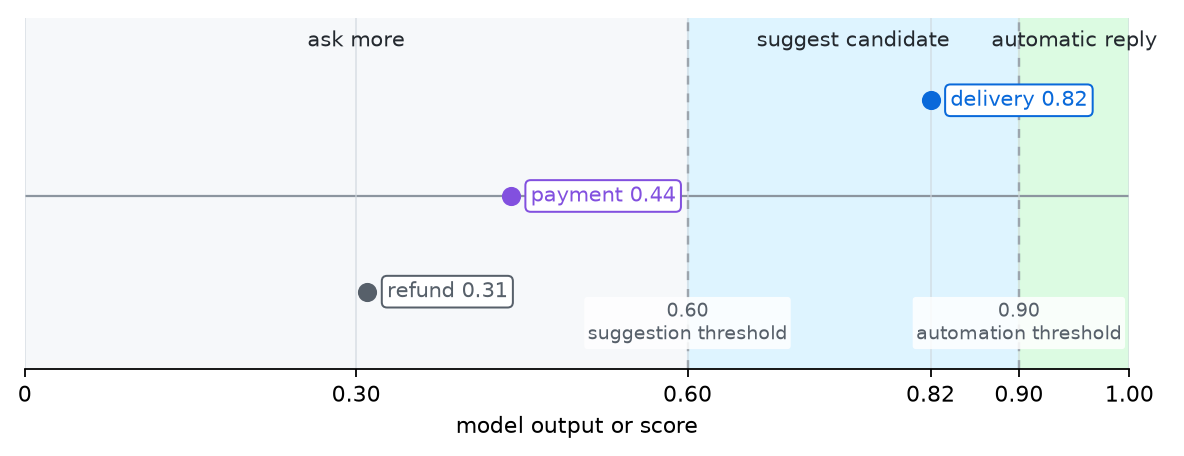
That threshold is not necessarily part of the probabilistic model itself. It may simply be the operating rule that decides how output becomes action. Google’s Machine Learning Glossary also explains that a classification threshold is a value selected by humans and that its choice affects false positives and false negatives.
So these are safer readings:
| Confused reading | Safer reading |
|---|---|
| if the score is above 0.90, it must be true | 0.90 or above is the operating standard chosen for automatic handling |
| the threshold is a parameter the model learned | the threshold may be a separate rule chosen by people or tuning procedure |
| because there is a threshold, this is already a probabilistic model | thresholds can also function as heuristics or policy standards |
In many systems, thresholds are heuristics laid on top of model output.
Heuristics and Probabilistic Models Can Work Together
The two are not opponents. They can be combined.
Think of a spam filter:
| Component | Example |
|---|---|
| heuristic | if the title matches a certain risky pattern, mark it for early attention |
| probabilistic model | estimate spam probability from email body and sender information |
| calibration | check whether outputs such as 0.80 match observed frequencies |
| operating rule | move to spam folder above 0.95, show warning between 0.70 and 0.95 |
| human review | never auto-delete critical business mail immediately |
In that structure:
the heuristic reduces candidates or decides inspection order
the probabilistic model expresses plausibility numerically
calibration checks whether the number deserves probabilistic trust
operating rules turn those numbers into action
This layered reading is more accurate than a score came out, so the system simply acted.
A Modern Caution
In modern AI systems, the boundary can look blurrier because many numeric criteria overlap in one pipeline:
| Modern situation | Where confusion appears | Safer distinction |
|---|---|---|
| LLM output generation | next-token probabilities and prompt-writing tricks are mixed together | separate the model’s internal probabilities from human-designed prompt heuristics |
| RAG retrieval | retrieval score is mistaken for factual reliability of the answer | retrieval score measures document relevance, not final factuality |
| agent execution | tool-order choice is mixed with model inference | tool sequencing may be a workflow heuristic |
| automated evaluation | a high score is read as automatic truth | check whether the evaluation function actually reflects the real goal |
Especially in generative AI, plausible output can look like verified fact. That is why this book keeps evidence, verification, and policy layers separate from the fact that a score or probability was produced.
If We Generalize This Intuition
At first encounter, it is tempting to interpret heuristics as an attempt to reflect uncertainty in software. The safest generalization for this book is:
a heuristic is an empirical standard that lets software choose the next candidate
under uncertainty and computational limitsa probabilistic model expresses uncertainty with numbers or distributions
and makes it possible to update belief when evidence changes
This preserves the useful beginner intuition without collapsing the standard boundary between the two ideas.
Checklist
- Explain why
heuristicandprobabilistic modelshould not be used as if they were the same thing. - Distinguish a heuristic score from a probability.
- Explain why a classification threshold may be an operating standard rather than the model itself.
- Explain why heuristics do not calculate uncertainty so much as make judgment possible under uncertain conditions.
- Explain how heuristics, probabilistic models, calibration, and operating rules can coexist inside one system.
- Explain how scores, probabilities, thresholds, and operating standards play different roles inside one system.
- Distinguish which part is the model's job and which part is system design.
Sources and Further Reading
- David L. Poole, Alan K. Mackworth, Artificial Intelligence: Foundations of Computational Agents, 3rd ed., 3.1 Problem Solving as Search, accessed 2026-06-23.
- David L. Poole, Alan K. Mackworth, Artificial Intelligence: Foundations of Computational Agents, 3rd ed., 9.1 Probability, accessed 2026-06-22.
- Stuart Russell, Peter Norvig, Artificial Intelligence: A Modern Approach, 4th US ed., Full Table of Contents, accessed 2026-06-22.
- Google for Developers, Machine Learning Glossary, accessed 2026-06-23.
- scikit-learn, 1.16. Probability calibration, accessed 2026-06-23.