P5-8.1 How to Add Constraints to the Objective Function: Regularization
Section ID:
P5-8.1Version:v2026.07.26
In Chapter P5-7, we saw that the optimizer is the rule that turns gradients into actual updates. But even if the training loop runs smoothly, that does not immediately mean the model will also hold up on new data. The next question appears right away.
What should we do if a model fits the training data very well, but does not perform well on new data?
One of the core concepts that answers this question is regularization. Chapter 8 is the chapter where we read what kinds of control devices are added to make the learning loop more stable. This section first deals with what kind of constraint should we place on the objective function.
Regularization is the idea of adding constraints or costs to the learning process so that the model does not fit the training data too aggressively.
When you need to distinguish overfitting control from normalization again, return to the glossary entry on regularization.
The Question Regularization Adds to the Objective Function
- Why does regularization enter the learning loop?
- How is it related to overfitting?
- How does regularization change the objective function?
- Why does it become more important when we look at model size and data size together?
It is safer to read this section not merely as one more option added after the optimizer, but as the section that separates the update rule from the preference condition that shapes where updates are allowed to go. Dropout is covered next in P5-8.2 as structure-level control, and the computational difference between training mode and evaluation mode reconnects in P5-6.4.
| What to distinguish in this section | Why it matters |
|---|---|
| optimizer | Because it is the procedure that looks at gradients and decides the actual stride of the update. |
| regularization | Because it is the viewpoint that constrains movement so it does not go toward an overly complex solution. |
| normalization | Because unlike overfitting control, it is the question of making value scales and distributions easier to handle. |
Standards for Constraints and Generalization
- You can explain regularization as
a constraint for reducing overfitting. - You can distinguish the roles of the optimizer and regularization.
- You can explain why regularization and normalization answer different questions.
- You can describe how regularization relates to the loss function, model size, and data size.
- You can explain that regularization plays the role of an
objective-function control deviceinside Chapter 8. - You can compare training loss, validation loss, and weight size together through an executable Python example.
Why Are Regularization and Normalization Different
The regularization discussed in this section is regularization in the narrow sense. But in practice the words normalize and normalization also appear often, so they are easy to mix up at first.
The names are similar, but the questions they target are different.
| Item | regularization | normalization |
|---|---|---|
| First question it tries to answer | How do we keep the model from memorizing too aggressively? | How do we make the scale of inputs or intermediate values easier to handle? |
| Main concern | generalization, overfitting control | value range, distribution, learning stability |
| Typical examples | L2 penalty, dropout, early stopping | input normalization, batch normalization, layer normalization |
In other words, regularization is closer to what kind of solution should we like less, while normalization is closer to what value range and distribution make the computation easier to handle.
Of course, in real deep learning the two are not completely separate. For example, batch normalization is more directly connected to computational stability and training speed, but in the end effects similar to regularization are sometimes observed as well. Even so, at the introductory stage it is safer to divide them like this first.
- regularization:
a device that keeps the model from memorizing too aggressively - normalization:
a device that makes value scales and distributions easier to handle
Why Is Regularization Needed
Deep learning models have high expressive power. That is a strength, but at the same time it also means they can end up following accidental patterns or noise in the training data.
For example:
- the loss on the training data keeps decreasing
- but on the validation data, performance stops improving at some point or even gets worse
This situation connects directly to the overfitting we saw in Part 4.
Regularization appears exactly here. It imposes the constraint: fit the training data, but do not fit it in an overly complex way.
This is easier to see with a curve. If the training loss keeps going down while the validation loss starts rising again at some point, the model may be moving toward memorizing the detailed patterns of the training data better and better.
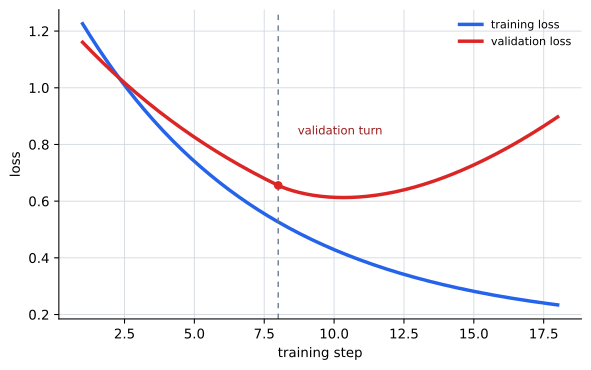
In this graph, regularization is not trying to look only at the minimum training loss. The key is to see together whether the loss on new data improves as well, or whether the gap is widening in the direction of fitting only the training data better.
From a beginner's point of view, it is useful to pin this scene down one more time in a shorter form.
| The number we see first | The question we should ask right after | Why regularization appears |
|---|---|---|
| training loss keeps going down | is the validation loss improving too? | Because we do not want to leave the model at a solution that fits only the training data. |
| training accuracy is high | does the same decision hold up when the input changes a little? | Because we want to make overly sensitive solutions less preferred. |
| the model became more complex | is that complexity also needed on new data? | Because large weights and complex rules can lead to overfitting. |
What Is Regularization Trying to Prevent
Here it is enough to understand the purpose of regularization in the following three lines.
- It keeps the model from depending too heavily on excessively large parameters.
- It keeps the model from memorizing only accidental patterns from specific samples.
- It helps the model work more stably on new data as well.
In other words, regularization is not just about lowering the loss. It is the idea of constraining how the loss is allowed to be lowered.
Does Regularization Only Mean a Penalty
Introductory textbooks often present regularization as adding a penalty term to the loss function. That explanation is important, but by itself it is somewhat narrow.
In deep learning, it is better to see regularization more broadly.
For example, the following can also be read as regularization in a broad sense.
- penalties that control weight size
- methods like dropout that randomly cut some connections
- strategies like early stopping that avoid training too long
- methods like data augmentation that increase input diversity
So regularization is closer to a design philosophy for reducing overfitting than to a single formula.
How Is It Related to the Loss Function
Regularization often appears together with the loss function.
It is enough to read this expression as follows.
data loss: how different the prediction is from the answerregularization term: whether the model is going in an overly complex direction
In other words, regularization adds not only the cost of matching the answer, but also the cost of using too much complexity.
Because of this, the optimizer no longer reduces only the original loss. It reduces the whole objective after regularization has been reflected.
Compressed very briefly, the connection looks like this.
flowchart TD
  A["Model prediction"]
  B["Data loss"]
  C["Regularization term"]
  D["Total objective"]
  E["Less extreme parameter preference"]
  F["Better generalization direction"]

  A --> B
  B --> D
  C --> D
  D --> E
  E --> F
The first result to confirm in this diagram is that regularization is not another loss that calculates the error instead, but a device attached beside the data loss that changes the total objective function and thereby makes the model prefer less aggressive solutions.
How Is It Related to Model Size and Data Amount
The scenes where regularization is needed more often can usually be read as follows.
- the model size is large and expressive power is high
- the amount of data is relatively small, or
- the data contains a nontrivial amount of accidental patterns and noise
In that case, the model may easily find a solution that fits the training data very well, but there is weaker reason to believe that solution will hold up on new data too. So it is not that a large model always needs regularization no matter what, but rather that we must look together at how sufficient the data is compared with the freedom the model has.
By contrast, when there is more data and the patterns are distributed more evenly, the chance that the model gains performance mainly by memorizing accidental combinations from specific samples is relatively lower. So regularization is more accurately read not just as a penalty term beside the loss function, but as a judgment standard that considers model size, data amount, and how well the model holds up on new data together.
What Is Different Between the Optimizer and Regularization
Readers may feel that both the optimizer and regularization are things that adjust learning. But their roles are different.
| Item | Role |
|---|---|
| optimizer | decides how to update parameters based on the gradient |
| regularization | imposes constraints on which kinds of solutions are preferred and which kinds of complexity are avoided |
That is:
- the optimizer deals with
how should we move - regularization deals with
which directions should we like less
This distinction has to be fixed first so that later weight decay, dropout, and early stopping can be grouped under one viewpoint more easily.
Looking at it one more time more slowly, the optimizer and regularization are inside the same learning loop, but the reader is looking at them from different positions.
| What we look at first in the learning loop | What we look at next |
|---|---|
| how the optimizer receives the gradient and moves the parameters | how regularization limits the kind of solution that movement is allowed to approach |
is it descending well? | is it descending toward an overly aggressive solution? |
Cases and Examples
Reading The Same Training Performance Back Through Different Standards
Suppose we build a model that predicts customer churn from a small tabular dataset. On the training data, two models fit almost equally well. But model A changes its prediction dramatically when the value of a particular column moves only a little, while model B gives similar training performance yet reacts less aggressively to changes in the input.
At first it may seem enough to choose the model with the lower training loss. But if we want a model that holds up on new data, the question has to change. We should not look only at how well did it fit, but also at how large were the weights and how sensitive were the rules it used to achieve that result. Regularization works exactly here as the standard that makes more aggressive solutions less preferred even within the same learning direction.
The result to check in this case is not the best training score. When there are two solutions that fit similarly well, the question is whether we choose the one that is more likely to wobble less on new data rather than the one that uses larger weights and higher sensitivity.
flowchart TD
  A["Similar training fit"]
  B["Old reading: lower training loss is enough"]
  C["Check weight size"]
  D["Check prediction sensitivity"]
  E["Regularization view"]
  F["Prefer the less aggressive solution"]
  G["Verify validation loss and input-change stability"]

  A --> B
  B --> C
  C --> D
  D --> E
  E --> F
  F --> G
If we read the case through this flow, the difference between regularization and normalization also becomes less confusing. Matching the units of input columns and putting value ranges into a form that is easier to handle is closer to normalization. By contrast, what regularization looks at in this case is not what range should we convert the values into, but whether the model uses excessively large weights or overly sensitive rules in order to fit the training data.
If we compress the core comparison of regularization into one scene, it becomes both fit the training data similarly, but one side uses larger weights and a more complex path.
| Comparison question | More aggressive solution | Less aggressive solution |
|---|---|---|
| Degree of fit on the training data | fits similarly well | fits similarly well |
| Weight size and complexity | larger | smaller |
| Sensitivity to input changes | higher | lower |
| Which side regularization prefers | no | yes |
flowchart TD
  A["same training-data fit"]

  subgraph HIGH["more aggressive solution"]
    B["larger weights"]
    C["more sensitive to input shifts"]
  end

  subgraph LOW["less aggressive solution"]
    D["smaller weights"]
    E["less sensitive to input shifts"]
  end

  A --> B
  A --> D
  B --> C
  D --> E
  C --> F["less preferred by regularization"]
  E --> G["more preferred by regularization"]
The first points to fix from this comparison diagram are the following.
- Regularization does not mean
do not match the answer. It means that, between two solutions that fit similarly, the more aggressive one is made less preferred. - So the comparison standard cannot be only
which error is closer to 0. It also has to includehow large the weights were and how complex the solution was in order to produce that error. - Only when this viewpoint is fixed can we read the example below not as
a term that interferes with loss reduction, but asa term that makes the model prefer a less aggressive solution.
Practice and Example
The goal of this example is to read regularization not as a technique that lowers training loss a little more, but as a constraint that makes us look at validation loss and weight size together. We will place a small training log in a CSV file and compare a setting without regularization with a setting that uses L2 regularization.
Input:
- Training log CSV:
regularization-training-log.csv model: a setting without regularization and a setting with L2 regularizationepoch: training iteration numbertrain_loss,validation_loss,weight_size: training loss, validation loss, and weight size
Output:
- the epoch with the lowest validation loss for each model
- the gap between training loss and validation loss at the last epoch
- how much weight size increased as learning progressed
Problem situation:
- If we look only at training loss, the setting without regularization can look better.
- But if validation loss rises again and weight size keeps increasing, we have to ask whether the solution will hold up on new data.
Concepts to confirm:
- regularization keeps us from looking only at training loss
- we need to look together at the point where validation loss was lowest and the final point
- even in a similar learning direction, a solution that keeps smaller weights may be a less aggressive solution
Input:
One row of the CSV is a summary recorded after one epoch for one model setting. Here we do not use an actual deep-learning library. We only read an already recorded training log and check the judgment criteria.
Before reading the code, it helps to predict which side will have the lower training loss and which side will look more stable in validation loss and weight size.
| Comparison item | Comparison to predict first | Reason for the prediction |
|---|---|---|
| final training loss | the setting without regularization is likely to be lower | Because it can fit the training data more strongly without a constraint. |
| final validation loss | the setting with L2 regularization is likely to be lower | Because it makes large weights and aggressive solutions less preferred. |
| weight-size increase | the setting without regularization is likely to be larger | Because it does not separately pay a cost for using a complex solution. |
The purpose of this table is to read training loss, validation loss, and weight size together.
In the output, do not look at only the final training loss first. Check when validation loss was lowest and how much it rose again after that.
- Without regularization, the final training loss is lower at
0.19. - But the final validation loss rises to
0.74, and the gap between training loss and validation loss widens to0.55. - With L2 regularization, the training loss is higher at
0.33, but the final validation loss is0.47and weight growth is smaller.
If we look at these numbers again as curves, the comparison axis that regularization asks us to read becomes clearer.
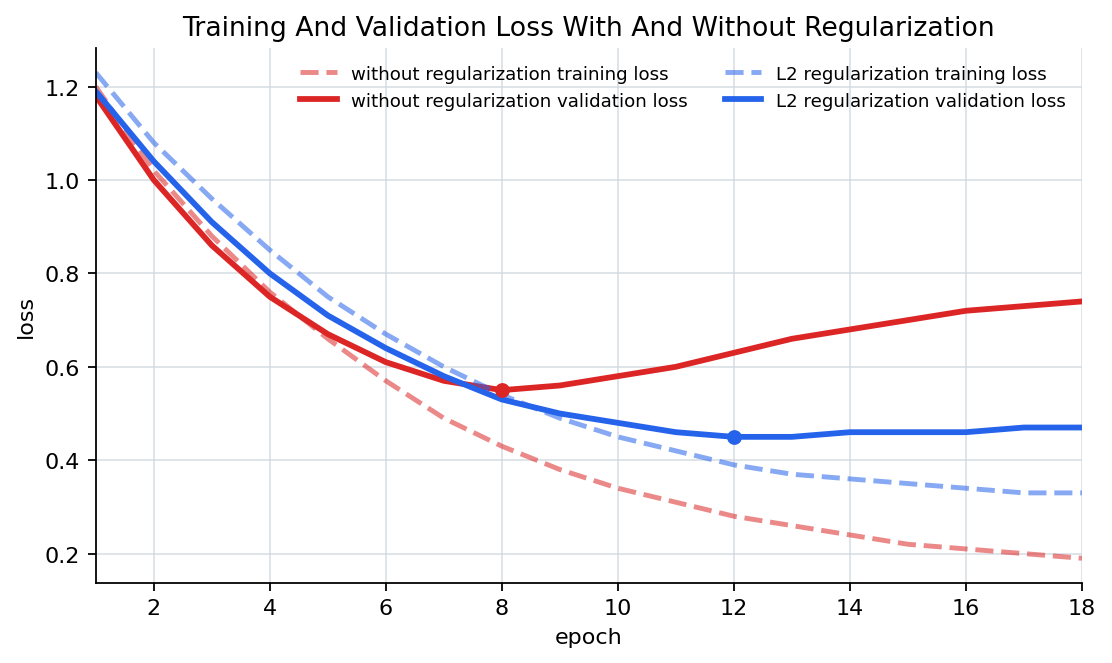
In the first graph, we should not simply choose the line with the lower training loss. In the setting without regularization, training loss keeps going down, but validation loss starts rising again after epoch 8. The setting with L2 regularization lowers training loss less aggressively, but keeps the validation-loss rebound small.
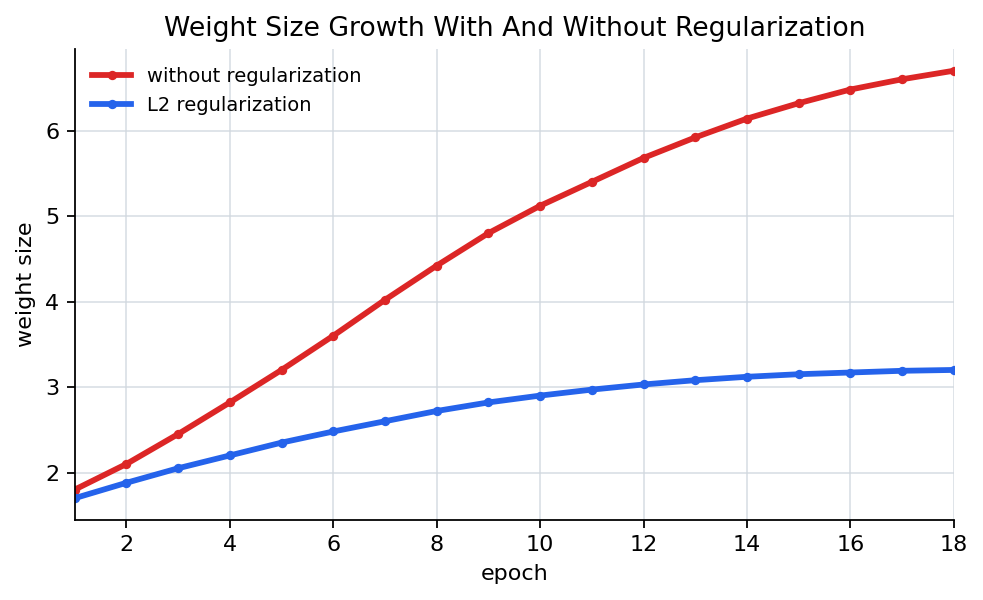
The second graph asks which solution depends on larger weights during the same learning process. The setting without regularization keeps increasing weight size, while the setting with L2 regularization has a much gentler increase.
| Comparison | The key to read here |
|---|---|
without_regularization | It fits the training data more strongly, but validation loss rises again and weight size increases greatly. |
with_l2_regularization | If we look only at the lowest training loss, it can look worse, but it is more stable in validation loss and weight size. |
Even when reading the output numbers, we need to separate error reduction from preference for a less aggressive solution.
| Comparison | What appears first in the output | Interpretation that is easy to leave if we look only at error | Interpretation that changes once we include regularization |
|---|---|---|---|
without_regularization | The final training loss is lowest. | It is easy to see it as the best-trained model. | If we also look at the validation-loss rebound and large weight growth, it may be a solution that overfits the training data. |
with_l2_regularization | The final training loss is higher. | It is easy to see it as a model that intentionally lowered performance. | If we also look at validation loss and weight size, it is a setting that prefers a less aggressive solution and leaves more room to hold up on new data. |
In other words, the question readers should hold onto in this example is not does regularization stop training loss from going down, but does it help validation loss and weight size hold up together while training loss is being reduced.
Regularization is also deeply connected to statistical learning theory from before deep learning. The problem that a model can fit the training data well while generalizing poorly if it becomes too complex has long been a central theme.
The reason regularization became even more important in the deep-learning era is clear.
- model capacity became very large
- bias and noise problems in data distributions remained
- high training performance alone cannot guarantee a good model
From the curriculum point of view, it is natural for this section to come after the optimizer sections.
- the previous P5-7.1 and P5-7.2 dealt with
how should we descend - the optimizer deals with how to descend well
- regularization deals with how far we should allow the descent to go, and which solutions should be preferred more
That is, both sections adjust learning, but they answer different questions.
Where Should We Place Regularization in the Learning Loop
The point where this section becomes necessary is when the phrase training is going well starts getting mixed up with it fits only the training data well. Regularization is not a decoration outside the learning loop. It should be placed beside the optimizer, while their roles are read separately.
| Problem scene that appears first | Why the regularization viewpoint helps first | Where it leads next |
|---|---|---|
| training performance is high but validation performance is unstable | It lets us read the generalization problem separately from does it fit better. | It leads to dropout in P5-8.2, which shakes the structure itself. |
| the optimizer and normalization both look like similar adjustment devices | It lets us separate the questions of update rule, value-scale adjustment, and generalization constraint. | We need to look further at the difference in control location in P5-8.2 and P5-8.3. |
| a large model seems to depend too heavily on one feature | It helps fix the regularization intuition of deciding which kinds of solutions should be less preferred. | We then need to look at structural regularization beyond penalties as well. |
| it is unclear why we need to be more careful when data is scarce | It explains why overfitting-control devices become more important when the dataset is small. | We need to look at practical forms such as dropout and early stopping next. |
Checklist
- Can you explain that regularization is a viewpoint for reducing overfitting?
- Can you distinguish that the optimizer and regularization answer different questions?
- Can you explain that regularization is the idea of adding constraints or costs to reduce overfitting?
- Can you explain why generalization does not automatically improve just because the optimizer works well?
- Can you distinguish regularization from normalization as
overfitting controlversusorganizing value scales and distributions? - Can you say that regularization can be seen not only as a penalty formula but also as a broader design philosophy?
- When the optimizer works well but validation performance is unstable, can you think first of the generalization problem from the regularization viewpoint?
- Do you understand that this section plays the role of
objective-function controlin Chapter 8, and that the next section moves on to dropout, which shakes the structure?
Sources and References
- Trevor Hastie, Robert Tibshirani, Jerome Friedman,
The Elements of Statistical Learning, 2nd ed., Springer, 2009, checked on 2026-07-19. https://hastie.su.domains/ElemStatLearn/ - Ian Goodfellow, Yoshua Bengio, Aaron Courville,
Deep Learning, MIT Press, 2016, checked on 2026-06-29. https://www.deeplearningbook.org/ - Christopher M. Bishop,
Pattern Recognition and Machine Learning, Springer, 2006, checked on 2026-07-19. https://link.springer.com/book/9780387310732