P5-14.5 How Do Sequential State and Direct Re-Reference Split in Long Context?
Section ID:
P5-14.5Version:v2026.07.31
When reading a long-context example, separate early_rule, current_request, distractor_context, reference_path, and final_decision_basis. These fields reveal which earlier clue the final judgment used as evidence, rather than only whether the model remembered earlier content for a long time.
In P5-14.4, we saw how RNN sequential state passing and Transformer relation computation differ from the viewpoint of parallel processing. The observation point in P5-14.5 is not GPU efficiency, but how the final judgment in a long context attaches earlier cues again as evidence.
In long context, is the important thing remembering for a long time, or referring again to the earlier position that is needed?
The comparison target is not the full Transformer implementation. It is the difference between compressing an earlier rule into one state and carrying it forward and letting the current question find the earlier sentence it needs again. We covered the computational efficiency of parallel processing in P5-14.4, and here we look only at the path by which a distant cue is attached again to the final judgment.
Questions Handled by Long-Context Re-Reference and the Experiment
- Why can sequential state passing weaken in long context?
- Why does self-attention give the feeling that it can refer more directly to a faraway earlier position?
- How can sequential state and direct re-reference make different final judgments even in the same long context?
Comparing Sequential Passing and Direct Re-Reference
In an RNN, distant information has to pass through several steps of state before reaching the current point. In self-attention, by contrast, the earlier cue does not only have to be compressed into one state and carried forward. The current position can compute relation scores with earlier positions again. That is why even a faraway cue is read as being referred to more directly from the current judgment position.
Here, a relation score is the relevance obtained when the final request position compares itself with earlier cues again. The final request position compares the earlier rule line, current-state line, and unrelated log lines in the same way. Lines that strongly connect to the current request rise again as evidence, while weakly related lines are pushed back.
For example, if the final question is Can line 3 restart now?, the question position must compare itself again with the earlier must not be restarted rule and the pressure has not returned to the safe range state. When that comparison happens, the cue at the front of the long context is not merely remembered for a long time; it is attached again as evidence at the final judgment point.
First, the overall conceptual path looks like this. An earlier cue can move inside compressed sequential state, or it can be compared again from the current question position.
flowchart TD
  A["earlier clue<br/>rule / definition / first log"]
  B["sequential state carry<br/>compressed through middle text"]
  C["current question<br/>final decision point"]
  D["direct re-reference<br/>compare the needed clue again"]
  E["evidence-backed decision"]

  A --> B
  B --> C
  A -. "needed clue" .-> D
  C --> D
  D --> E
Now, if we split the same request only into the two computation paths, it can be read as follows. This diagram compares how the final request reaches a judgment through different evidence paths, rather than showing the whole long-context structure again.
flowchart TD
  A["same request: can line 3 restart now?"]

  subgraph RNN["sequential state carry"]
    B["carry the earlier rule in state"]
    C["the rule can weaken while passing through middle logs"]
    D["decide from the remaining state at the final request"]
  end

  subgraph TR["direct re-reference"]
    E["current request position"]
    F["look up the earlier rule and pressure-state line again"]
    G["recombine the needed evidence for the decision"]
  end

  A --> B --> C --> D
  A --> E --> F --> G
| Viewpoint | Sequential State Passing | Direct Re-Reference |
|---|---|---|
| movement of earlier cue | passed through intermediate state | the current position looks again at the earlier position it needs |
| long-context risk | the cue can weaken as intermediate information grows | the relevant earlier position is more likely to be brought back up |
| final judgment | depends on cue strength left inside the state | depends on relation computation between the current request and earlier evidence |
If we read the long-context problem only as memory, we only ask whether the model keeps holding earlier content for a long time. But the more important feeling in the Transformer structure is whether the current position can refer again to the earlier position it needs.
Cases and Examples
Case. Restart Request While Pressure Has Not Returned
Consider a long work-permit question and answer.
| Candidate Cue | Relation to the Final Judgment | Direct Re-Reference View |
|---|---|---|
Do not restart line 3 before pressure is relieved | restart blocking rule | earlier cue that must be called again |
Current pressure has not yet returned to the safe range | state where the rule still applies | earlier cue that must be called again |
Sensor calibration was completed in the morning | does not mean pressure returned to the safe range | weak cue that can be confused |
Shift handoff records were updated | weak direct relation to restart-safety judgment | cue to push away from the judgment center |
Can line 3 restart be approved now? | current question | position that must attach the earlier rule and state again |
The easy criterion a person may use first is the model read a lot, so it should remember the earlier content. But the result to confirm in this case is not did it remember a lot? It is whether the blocking rule and current pressure state were attached again as evidence at the final judgment point.
The sequential-state method tries to compress the earlier rule into one state and carry it to the end. As intermediate logs increase, the blocking-rule axis can weaken. The direct re-reference method finds the rule line and pressure-state line again at the final request point.
Compressing into one state does not mean the earlier cue disappears. But each new line also mixes sensor calibration, material restocking, shift handoff, and other information into the state. If the blocking rule does not remain clear as separate evidence by the time the final request arrives, the model can be pulled more by recent logs or approval-related words than by do not restart.
The judgment sentence in this case should settle as follows.
| Method | Judgment Sentence |
|---|---|
| only weak sequential state remains | the earlier blocking rule may not remain strongly enough until the final request, so the judgment can become uncertain |
| direct re-reference found the needed cues | the final request attaches the blocking rule and current pressure state again as evidence, so it judges toward blocking the restart |
Practice and Example
Practice. Separate Needed Earlier Cues and Distracting Cues
Classify each candidate cue below as needed, weak, or similar to distracting.
| Candidate Cue | Classification | Explanation |
|---|---|---|
Do not restart line 3 before pressure is relieved | needed | this rule directly blocks the final restart-approval question |
Current pressure has not yet returned to the safe range | needed | this checks whether the blocking rule still applies |
Sensor calibration was completed in the morning | weak | sensor calibration is not the same as pressure returning to the safe range |
Packaging material replenishment was separately approved | similar to distracting | even though it contains the word approved, it has weak direct relation to line-3 restart approval |
Explanation: The learning point in a long-context problem is not it read a lot, but it attached the evidence needed for the final judgment again. We must not only choose the needed cues, but also push cues with weak direct relation away from the judgment center.
Example. Comparing a Sequential Reader and a Direct Reference Reader
This example is not a Transformer implementation. It is an experiment comparing what observations two reference methods leave in long-context judgment. direct_reference_reader is not actual attention computation; it is a compressed model that uses keyword scores to reorder earlier lines. What we check here is not whether the code reaches a predetermined answer, but the output difference between a cue weakening inside state and a cue rising again from the current request.
| Value to Manipulate | Output to Observe | Question to Check |
|---|---|---|
decay | sequential_support, final_state | how quickly does the earlier rule weaken inside sequential state? |
number of intermediate Log: lines | final value of the block axis | does sequential state shake more as unrelated intermediate sentences increase? |
final Request: sentence | top matched lines, scores | which earlier lines share stronger word axes with the current request? |
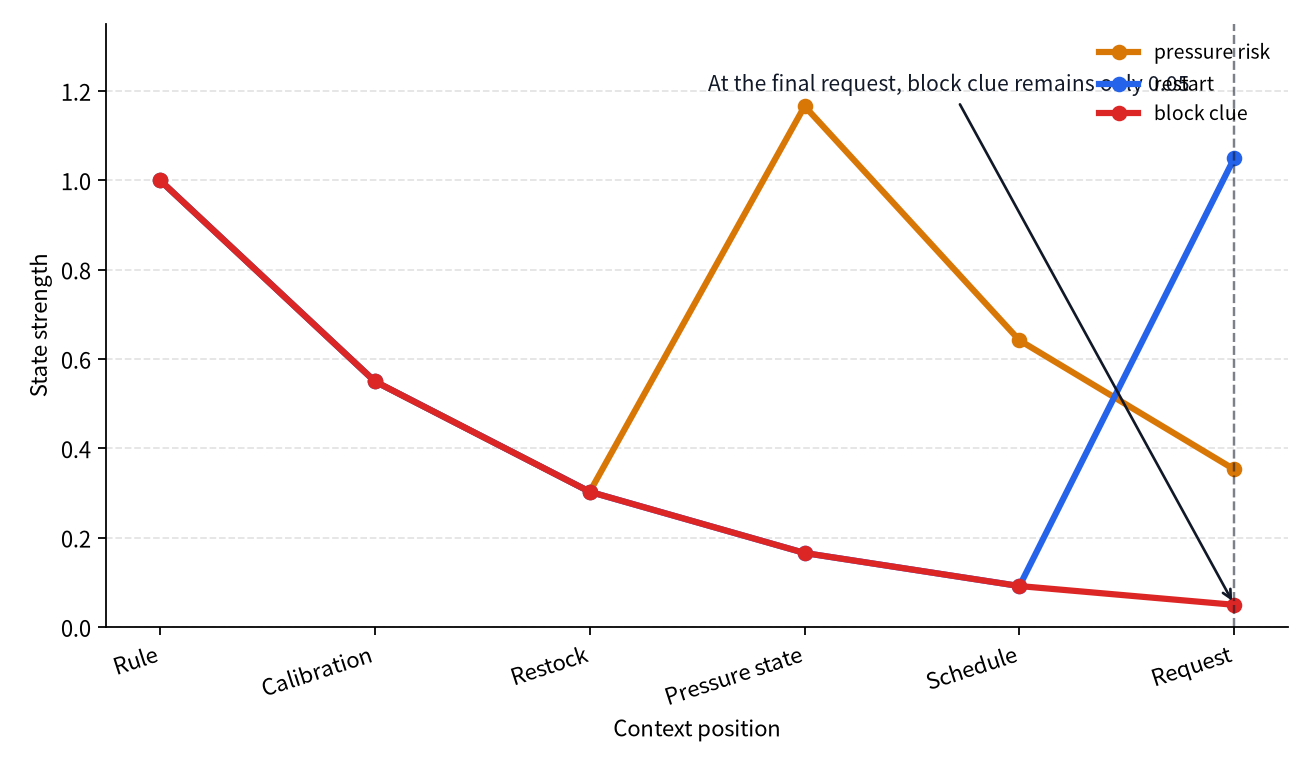
Read the example output as follows.
The first output shows how sequential state weakens while passing through context. The block axis starts strongly at the rule line, but only 0.05 remains by the final request.
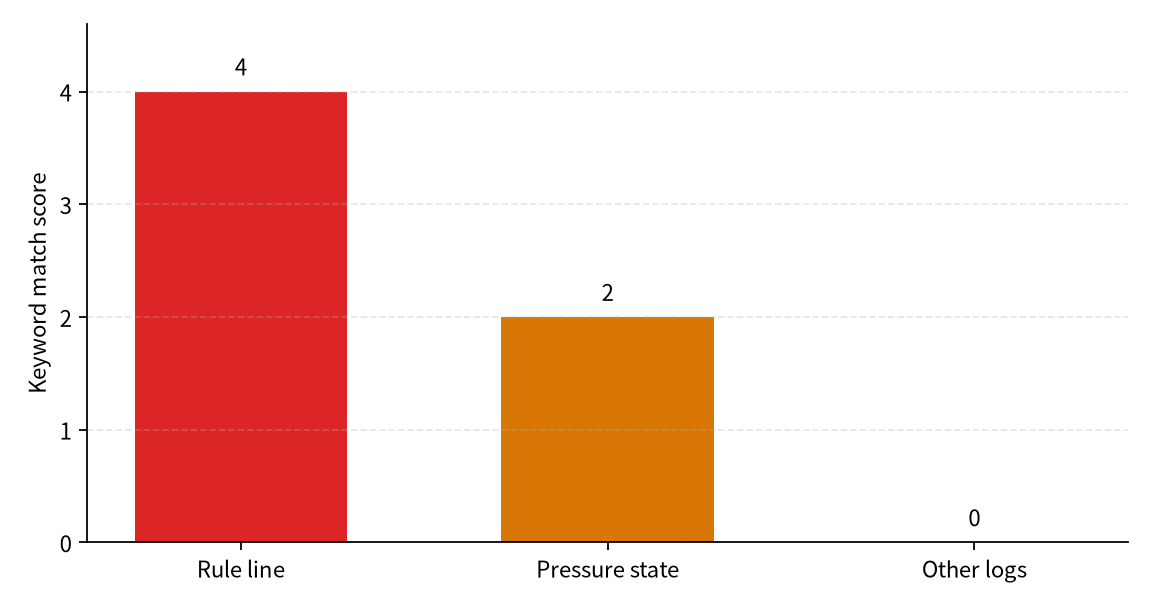
The second output shows which lines the direct re-reference method brings back at the final request. This code does not judge a fixed answer such as block the restart. Instead, it compares the word axes in the final request with those in earlier lines and shows whether the rule line and pressure-state line rise again as top evidence. The change to read in this example is not a decision label, but the difference between the earlier cue weakening inside the state and rising again from comparison with the current request.
Practice. Change Values and Check the Difference
| Value to Change | Expected Output Change | Explanation |
|---|---|---|
raise decay from 0.55 to 0.8 | sequential_support may grow | because sequential state keeps the earlier cue longer, the block axis created at the rule line weakens less by the final request |
| add three more intermediate logs | the sequential-state side can shake more easily | as intermediate lines increase, earlier cues inside state continue to decay, while direct re-reference can keep the judgment if it can find the matching earlier lines |
remove the word restart from the final request | the rank of the top matched lines can change | if the current request loses the key word connected to the earlier rule, the direct re-reference side also changes which earlier cue rises strongly |
Explanation: This practice is not saying that direct re-reference always guarantees the right answer. The core is to distinguish through output changes whether earlier cues weaken inside the state or rise again through comparison with the current request in long context.
Checklist
- Can you explain the long-context problem as a difference between sequential state passing and direct re-reference?
- Can you say that self-attention gives the feeling of referring more directly to distant positions?
- Can you explain the difference between
sequential_supportand the top matched lines? - Can you say that in long context, final judgment can change depending on how evidence is called?
Sources and References
- Ashish Vaswani et al.,
Attention Is All You Need, NeurIPS 2017, checked on 2026-07-19. https://papers.nips.cc/paper/2017/hash/3f5ee243547dee91fbd053c1c4a845aa-Abstract.html - Ian Goodfellow, Yoshua Bengio, Aaron Courville,
Deep Learning, MIT Press, 2016, checked on 2026-06-29. https://www.deeplearningbook.org/