P6-4.5 Supplement: Long Context and Sparse Attention
Section ID:
P6-4.5Version:v2026.07.26
Subtitle: How do sparse attention and long context separate computation burden from clue preservation?
In P6-4.2, we saw that attention and the context window connect to input-range constraints, and in P6-4.4, we organized KV cache as a device that handles what should not be recomputed in repeated generation. The remaining question now is on a different side.
When handling long input, do we really have to keep every connection?
The names often seen when reading along this question are sparse attention and long-context. Both connect to the long-input problem, but they are not the same technology name. Here, inside the broader background of long-context computation and maintenance problems, we read how to reduce the number of connections and how to keep key clues to the end in long context as different levels.
Computation Burden Left in Long Context
- What does sparse attention try to reduce?
- Why is long-context often called by a separate name?
- Why do the two names point not to the same technology name, but to different levels:
connection-count adjustmentandlong-context design as a whole?
The problem to close first here is not lumping the long input problem into one word, but separating it into two questions: computation burden and clue maintenance.
| What we handle now | What is passed to later chapters or later parts |
|---|---|
| The sparse attention direction that tries not to view every connection with the same density | Concrete architecture comparisons and latest benchmark competition |
| The long-context problem of keeping earlier clues to the later stage even in long input | Actual RAG, operating policies, and long-context product design choices |
This distinction must be fixed so sparse attention can be explained as a direction that does not maintain every connection with the same density, and long-context can be explained separately as the overall design problem of actually maintaining and referring back to long input.
What Does Sparse Attention Try to Reduce?
If basic self-attention is read very simply, each token computes relevance with many other tokens. As context becomes longer, the number of comparisons grows quickly, so the following question naturally appears.
Do we really need to inspect every position in detail with the same density every time?
Sparse attention is one direction for this question.
- Look more densely at nearby neighbors
- Select only some distant positions
- Reduce connections by fixed rules to lower computation burden
In other words, sparse attention is closer to not maintaining every connection with the same density, not throwing attention away.
It is safer to unfold this sentence one more time. Basic self-attention, stated very simply, is close to the sense that the current position looks around every other position once. When a sentence is short, this picture is not too burdensome. But when the input becomes long, such as thousands of log lines, long code files, or long contracts, the number of other positions one current position must check also grows quickly. Sparse attention is the side that asks, at exactly this point, do we really need to check every position equally every time.
So when first reading sparse attention, understand it as follows.
- It is not
removing all connections. - It is closer to
can some connections be kept, while others are checked less often or reduced by rule? - The core is lowering computation burden by adjusting
connection density.
This standard keeps you from misunderstanding sparse attention as a technology that reads context roughly. The concern is can necessary connections remain while less important comparisons are reduced.
Why Is Long-Context Called by a Separate Name?
Long-context is often used in a slightly broader sense than simply the input is long. The core is not only whether the model can insert a longer document, but whether it can maintain and refer back to earlier and later clues together inside that long input.
Long-context usually calls the following problems together.
- The problem of increasing the context-window number
- The problem of losing fewer important clues in long input
- The problem of cost, latency, and memory burden growing together in that process
In other words, long-context is closer to a term for the whole design of actually handling long context, not bragging about length.
It is useful to translate this sentence into a scene once more. When reading a 3-page contract, connecting an earlier definition clause again to a later exception clause is relatively easy. But when reading a 300-page document, the fact that many pages can be inserted alone is not enough. Whether the earlier definition is actually connected again to the later exception, whether key clues stay strong even when unnecessary middle content grows, and whether the cost and latency of handling that long input are bearable all remain as problems.
So long-context is not simply a name for boasting about a model with a large window number. More accurately, it is a name that groups the following questions together.
- Can long input be brought into computation?
- After bringing it in, are earlier clues and later clues actually maintained together?
- Is the maintenance process bearable in cost and latency?
In other words, long-context is better seen not as one feature that receives longer input, but as a bundle of design problems for maintaining long context to the end in actual tasks.
Why Sparse Attention and Long-Context Should Not Be Treated as the Same Thing
At first, the two names both look like technologies for solving long input, so it is easy to group them as one. In practice, both are connected to long-context problems, so they are not completely unrelated. But they do not immediately point to the same problem.
A safer distinction is as follows.
- Sparse attention first asks
how densely should connections be maintained. - Long-context first asks
can important clues actually be maintained to the end across the whole long input.
In other words, sparse attention can be one direction that helps long-context, but it does not mean the same thing as all of long-context. Reducing the number of connections does not automatically solve key clue maintenance. Conversely, thinking about designs for maintaining long context does not necessarily mean using only sparse attention.
The shortest way to hold this difference is as follows.
| First question to ask | More directly connected name | Why they differ |
|---|---|---|
Do we really need to inspect every position in detail? | Sparse attention | Because it is a problem of comparison count and connection density |
Do front clues actually survive to later work? | Long-context | Because it is a problem of maintaining key clues across the whole long input |
After reducing cost, did key clues also weaken? | Both | Because computation savings and clue maintenance intertwine at the same time |
The purpose of this table is not to completely separate the two names. Rather, it is to leave the sense that they are connected, but not the same level.
Difference Between Sparse Attention and Long-Context
| Name | First question to ask | Role |
|---|---|---|
| Sparse attention | Do we really need to inspect every token pair in detail? | Direction for reducing computation burden by reducing the number of connections |
| Long-context | Can front clues be maintained to the back even in long input? | Overall design problem for handling long context |
This distinction reduces misunderstandings such as does sparse attention remove attention and is long-context only a length number.
The diagram below shows how the same long input problem splits into two questions. Sparse attention is mainly closer to how much to reduce the connections to compare, while long-context is closer to how to keep necessary clues to the end.
flowchart TD
  A["Long input problem"]
  B["Computation burden<br/>too many token comparisons"]
  C["Clue retention<br/>important early signals fade"]
  D["Sparse attention<br/>reduce connection density"]
  E["Long-context design<br/>keep useful clues available"]
  F["Practical long-document behavior"]

  A --> B
  A --> C
  B --> D
  C --> E
  D --> F
  E --> F
Cases and Examples
Case 1. Long Log Analysis That Needs Sparse Attention
Imagine searching for the cause of an incident while reading thousands of system log lines. At first, it is easy to feel that comparing every line with every other line would be safest. But in practice, it is often enough to look densely at nearby time-range logs and refer back only to a few key error codes or session transition points far away.
When reading logs, people also usually do not compare every line with every line. Instead, they first narrow things as follows.
- Group consecutive logs from the same time range first.
- Search again for the same session ID or same error code.
- Recheck only state-change points, even if they are far away.
The standard changes here from view every line with the same weight to keep core connections while reducing unnecessary comparisons. Sparse attention touches this sense. The result to check is not does it see nothing, but can less important comparisons be reduced while necessary connections remain.
Case 2. Contract Reading That Needs Long-Context
Imagine reviewing a long contract where an early definition clause and a later exception clause must both not be missed. As the document gets longer, what matters more than how many pages were inserted is whether the front definition and later exception connect again inside the same task.
Suppose the beginning of the contract defines service interruption, and a later appendix says regular maintenance is not considered interruption. As document length grows, the dangerous failure is not only not enough of the document was inserted. Even if a fairly long document is inserted, if the early definition does not survive properly until the point of reading the later exception, the review can be wrong.
So the standard in the long-context case is whether the front clue actually leads to the later judgment, more than how many pages were inserted. The result to check is whether the early definition and later exception actually survive together even as document length grows.
When the two cases are placed together, a common misunderstanding is also organized. It is easy to feel that if the context-window number grows, the long-context problem is automatically solved. But even if input length increases, if key clues are not properly maintained to later work, the long-context design problem remains. Conversely, reducing computation burden can help process longer input, but that alone does not immediately justify the conclusion that key clues are maintained well to the end.
In other words, the biggest misunderstanding to guard against here is thinking if the length number grows, the long-context problem is over. Sparse attention mainly asks how much to reduce comparison, while long-context asks did what matters remain to the end.
Standards Revisited in Failure Scenes
At first, computation burden, length numbers, and key clue maintenance easily mix under the expression long input problem. In that case, rather than memorizing more definitions, it is safer to first separate what the current failure scene asks.
| Scene first visible now | First question to ask | More directly connected thing |
|---|---|---|
| As input gets longer, responses stutter and the number of positions to compare looks too large | Is every position really being viewed with the same density? | Sparse attention |
| A document is inserted at length, but the front definition or exception keeps weakening at the later judgment point | Do key clues actually survive to the later stage? | Long-context |
| The context-window number grew, but important front clues still blur | Are we mixing the problem of holding a lot with the problem of keeping what matters to the end? | Long-context |
| Computation burden must be reduced, and distant key clues must not be missed | Is the more urgent bottleneck comparison count, clue maintenance, or both? | Both |
The purpose of this table is not to completely detach sparse attention and long-context. When seeing an actual failure scene, it makes you first read separately how many connections should be maintained and how long important clues can be held.
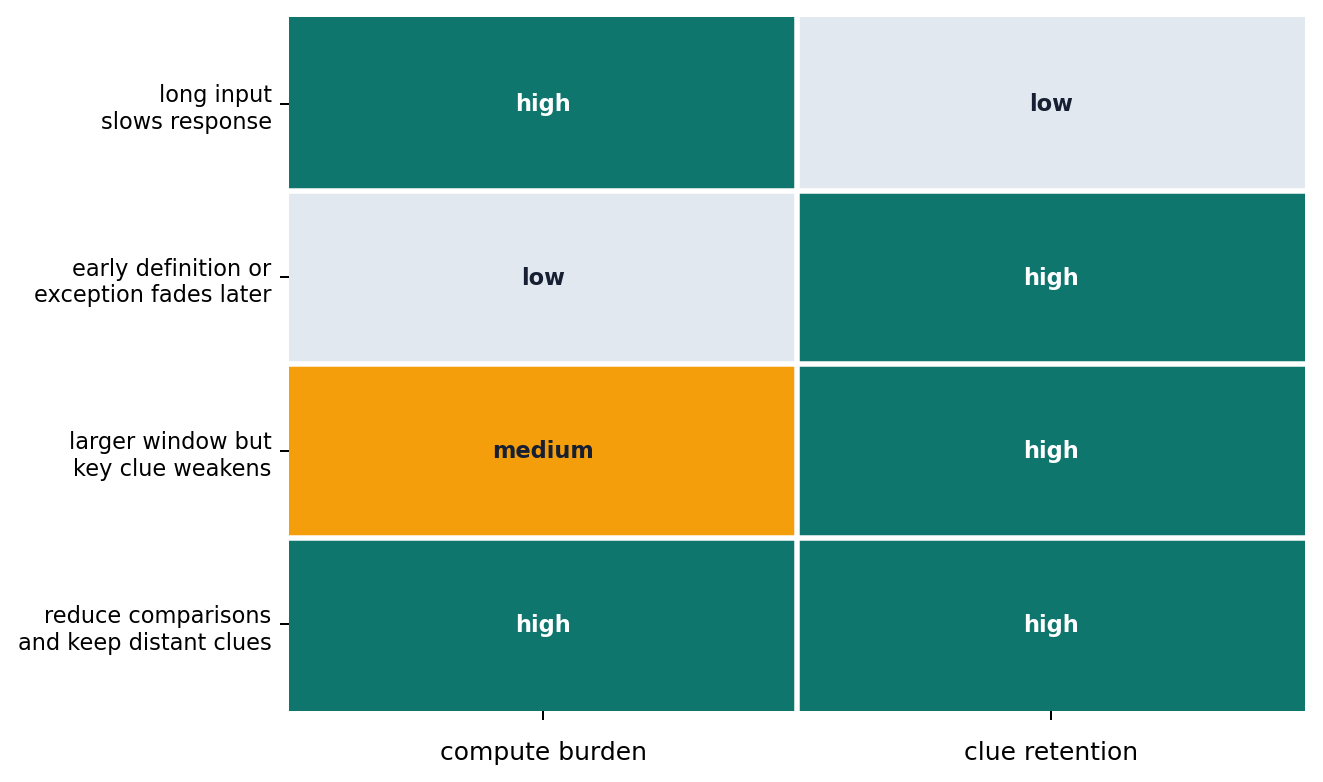
This distinction also shows where the two names touch. In long input, computation burden and clue maintenance often intertwine at the same time. But what to reduce and what to keep to the end are still different questions.
Practice and Examples
Look at the following scene and mark the problem separately as computation burden and clue maintenance.
Assume we insert long incident logs and a deployment document together to find the cause. The logs contain thousands of lines. The beginning of the deployment document explains token signature method change, and the later part contains the exception old-version sessions are allowed for 30 minutes. If the model is not to slow down, it needs a structure that does not compare every log line with the same density. If the answer is not to be wrong, the front change explanation and the later exception condition must survive to the end.
The sparse-attention-side question here is do we have to compare every log line and document fragment with the same density. The long-context-side question is do the front signature-method change and the later exception condition actually remain until the cause-judgment point. If both questions are visible together, the current scene connects to both.
It is useful to ask yourself one more time:
- Is what I vaguely called
long input problemnow a computation-burden problem? - Or is it a key-clue-maintenance problem?
- Or are both problems mixed at the same time?
If you can ask these questions first, you can greatly reduce the mistake of reading sparse attention and long-context as the same technology name.
Checklist
- Sparse attention is a direction that reduces computation burden by not maintaining every connection with the same density.
- Long-context points to the whole problem of actually maintaining and referring back to long input.
- Reducing the number of connections and maintaining long context well are not the same problem.
- Increasing the context-window number alone does not automatically solve the long-context problem.
Sources and References
- Ashish Vaswani et al., Attention Is All You Need, NeurIPS 2017, accessed 2026-07-19. Used as starting evidence for explaining that basic self-attention computes relationships among input positions.
- Rewon Child et al., Generating Long Sequences with Sparse Transformers, arXiv 2019, accessed 2026-07-19. Used as evidence for the direction of reducing attention-matrix computation burden with sparse factorization to handle long sequences.
- Manzil Zaheer et al., Big Bird: Transformers for Longer Sequences, NeurIPS 2020, accessed 2026-07-19. Used as evidence for the research flow of reducing full attention's sequence-length-dependent burden through sparse attention and handling longer input.
- Iz Beltagy, Matthew E. Peters, Arman Cohan, Longformer: The Long-Document Transformer, arXiv 2020, accessed 2026-07-19. Used as evidence for a long-document Transformer case that handles long-document tasks with local window attention and task-motivated global attention.