P6-10.2 Alignment That Separates Well-Followed Answers from Acceptable Answers
Section ID:
P6-10.2Version:v2026.07.26
In P6-10.1, we saw that instruction tuning is an adjustment step that makes a model respond more like a conversational assistant. But an answer that follows instructions well is not automatically safe or desirable.
Does following a user's instruction well automatically make a good AI system?
Alignment is the problem of how well a model's behavior fits human intent, safety standards, and social constraints.
Axes for Judging Acceptability
Acceptability starts from the following questions.
- What is alignment trying to align?
- Why are helpfulness, safety, and factuality not the same thing?
- Why can a model that follows instructions well still be dangerous?
The first thing we need for understanding alignment is a standard that does not mix helpfulness, safety, and factuality into one score. Prompts, RAG, evaluation, and operating policies are devices that move this standard into the real usage layer. If we divide the standards first, we avoid collapsing the answer is friendly, the answer is safe, and the answer is factually correct into one sentence.
Alignment is not a simple moral slogan. It is a design problem that necessarily appears when we use LLMs in real services. The key point is that does it follow well? and is it acceptable? are different questions. This Section first establishes why following instructions and behaving safely and acceptably are different, and why helpfulness, safety, and factuality should be read separately. Later Sections return to how these standards enter actual evaluation procedures, operating policies, prompts, RAG, and service operation.
To avoid mixing answering well with behaving acceptably, we need to read helpfulness, safety, and factuality as separate axes.
Separating Instruction Following from Acceptability
- You can explain alignment at an introductory level.
- You can distinguish helpfulness, safety, and factuality as different standards.
- You can say why instruction following and safety do not always point in the same direction.
- You can naturally connect this discussion to later evaluation, operation, and policy topics.
This standard is needed for the following reasons.
- It helps separate instruction following from safety.
- It prepares us to see why evaluation should use multiple axes.
- It creates a reading standard for later P6-17.1 LLM evaluation, P6-17.2 automatic and human evaluation, P6-18.1 service operating constraints, and P6-18.2 failure response in operation.
Judgment Axes in Alignment
Alignment is not the task of selecting a good answer with one score. It is the task of looking at several standards at the same time.
| Judgment axis | Question to check |
|---|---|
| Helpfulness | Does it actually help the user's work? |
| Safety | Does it reduce harmful outcomes or policy violations? |
| Factuality | Does it reduce unsupported claims or wrong information? |
| Acceptability | Even if it follows the instruction well, is there a point where it should stop or refuse? |
What Is Alignment Trying to Align?
The word alignment can sound abstract. It becomes clearer when unpacked with these questions.
- Does this model respond in the way users expect?
- What limits does it place on potentially harmful requests?
- Does it reduce plausible but wrong statements?
- Does it reflect social responsibility and service policy?
In other words, alignment does not simply mean giving kind answers. It asks how model behavior is designed to fit a set of standards.
Why Helpfulness, Safety, and Factuality Must Be Separated
These three expressions often appear together, but they do not mean the same thing.
| Standard | Central question |
|---|---|
| Helpfulness | Does it actually help the user's work? |
| Safety | Does it reduce harmful outcomes? |
| Factuality | Is it factually correct? |
For example:
- A fluent but wrong answer may look useful while having low factuality.
- An overly conservative answer may be safe while having low practical usefulness.
- Even if an answer follows the user's request well, it lacks safety if it helps a dangerous action.
Therefore, it is safer to view alignment not as a one-point score, but as a problem of handling several standards that can be in tension with each other.
Why a Model That Follows Instructions Well Can Still Be Dangerous
We need to hold this question first so that we do not mix following instructions well with what should be refused and where the system should stop.
A high instruction-following ability can mean that the model interprets the user's requested format well and can produce the desired form of answer. But user requests are not always safe or appropriate.
For example:
- A request that helps a dangerous action
- A request that could expose personal information
- A request to create a false claim in a confident form
In these situations, following well can increase risk.
So the fact that a model follows instructions better is not enough. The alignment problem of deciding where to stop and what to refuse almost always follows.
How Instruction Tuning and Alignment Differ
The two often appear in sequence in a real workflow, but they do not answer the same question.
| Distinction | What instruction tuning first targets | What alignment more directly targets |
|---|---|---|
| Central question | Does it answer well in the requested form? | Is the answer acceptable, safe, and policy-compliant? |
| Visible change when it works | A structure closer to an assistant response and a more natural response form | Refusal of risky requests, protection of sensitive information, softer unsupported certainty |
| Common misunderstanding | If the form improves, overall quality can feel finished | If refusal works well, it can feel sufficient |
Instruction tuning is closer to a layer that better matches how to answer. Alignment is closer to a layer that more directly handles how far to answer and which standards not to cross.
Alignment Is Also a Service Policy Problem
Alignment does not stay only inside model adjustment in a lab. In real services, the following also enter the problem.
- Which requests to refuse
- Which warnings to attach
- Which tool calls to block
- Which logs and audits to keep
In other words, alignment is not only a model problem. It is a structure jointly made by the application, tools, and operating policy.
A Flow That Passes Good Answers Through Multiple Standards
flowchart TD
  A["user request"]
  B["helpful answer"]
  C["safety check"]
  D["factuality check or grounding"]
  E["final response"]

  A --> B
  B --> C
  C --> D
  D --> E
The result to check in this diagram is that evaluation does not end with one good answer. Helpfulness, safety, policy compliance, and other standards are all involved at the same time.
Cases and Examples
Case 1. Medical Information Answer
Consider a medical information answer where a user asks how to take medicine. A fast and definite answer can feel convenient. When the answer gives a conclusion immediately, the user may feel helped. But in this area, a confident wrong answer can be the most dangerous result. For example, if the model gives a general answer without checking dosage, age, or existing conditions, it may look friendly while increasing real risk. The user may receive it like a short prescription, even though the question may require consultation with a medical professional first.
The change here is a move from first asking is it short and definite? to also asking does it check risk conditions and route the user to a safe path? From an alignment perspective, we need standards that produce helpful answers while also reducing excessive certainty, unsupported generalization, and risky instructions. The misunderstanding to correct is the expectation that kindness that answers immediately is a good service. The result to check in this case is not whether the answer is short and definite, but whether the actual output changes toward checking risk conditions or routing the user to human consultation, and whether the warning actually stops the judgment rather than merely appearing as a formality.
| Comparison point | Well-followed but risky answer | Answer that passes alignment standards |
|---|---|---|
| Medical information | It asserts that the medicine can be taken right away | It presents ingredients, existing conditions, and a professional confirmation path |
Case 2. Code Generation
Code that runs is not automatically a good answer. In a demo stage, it is easy to feel that it is fine if it runs. If there is no visible error, it looks like success. But code that works quickly by skipping authentication checks, or code that deletes files directly while omitting exception handling, can be useful on the surface and still be a serious security and reliability problem. For example, a script that passed on a development server can delete the wrong user's data in production. People evaluating the result also need to separate it runs from it runs safely.
The change here is a move from ending with execution success to also checking authentication, exception handling, and limits on risky operations. From an alignment perspective, usefulness and safety standards must be applied together to reduce this conflict. The misunderstanding to correct is the judgment that if the code runs, safety can be added later. The result to check in this case is whether authentication checks, exception handling, and risky-operation limits enter the actual output code, and whether risky operations are limited by default rather than allowed by default.
| Comparison point | Well-followed but risky answer | Answer that passes alignment standards |
|---|---|---|
| Code generation | It immediately creates the requested script, but has no authentication or confirmation step | It includes target confirmation, administrator approval, backup, and exception handling before execution |
Case 3. Internal Work Automation
In internal document automation, a nicely formatted and fast summary becomes an operating problem if sensitive information remains exposed. If the result is neat, people first feel that it was well organized. But customer names, contract amounts, and internal code names may still remain. For example, if an external version of a team meeting summary keeps an internal project code name, it is an incident regardless of summary quality. In this case, what matters is not only whether the answer is convenient, but whether it violates organizational policy and audit standards.
The change here is a move from first asking is it well summarized? to also asking what should remain and what should be redacted? under operating policy. Alignment is not an abstract ethical discussion. It is close to the problem of connecting what may be said and what must be hidden to operating policy. The misunderstanding to correct is the feeling that higher summary quality means higher shareability. The result to check in this case is whether sensitive information is actually redacted apart from sentence-summary quality, whether the output stays within external sharing standards, and whether the redaction standard is applied consistently inside the text.
| Comparison point | Well-followed but risky answer | Answer that passes alignment standards |
|---|---|---|
| Internal sharing | It summarizes the meeting quickly but leaves identifying information | It separates public content from information that must be hidden |
The three cases can be grouped again from an alignment perspective as follows.
| Situation | What is easy to miss when only apparent usefulness is checked | Safety standard that must also be applied |
|---|---|---|
| Medical information answer | The risk created by a definite immediate answer | Check risk conditions and guide human consultation |
| Code generation | The illusion that execution alone is enough | Authentication, exception handling, and limits on risky operations |
| Internal work automation | Satisfaction with a neat summary | Redaction of sensitive information and organizational policy compliance |
Scenes Where Alignment Standards Split
After reading this Section, even without yet knowing RLHF or policy details, you can practice first separating whether the current problem is a usefulness problem, a safety problem, or a factuality problem. If an answer is very friendly and direct but does not check risk conditions, the impression of helpfulness and the actual safety need to be judged separately. If an answer is so short and conservative that it prevents incidents but is almost useless in practice, the scene may lack practical usefulness rather than safety. If the wording is natural and confident but contains many unsupported claims, the problem is factuality, not tone.
The important point is not to finish with a one-line judgment of a good answer. It is to first read does it help?, does it reduce risk?, and is it factually correct? on different axes.
Common confusions here include the following.
- Kindness and safety can easily feel like the same thing.
- Many conservative refusals can be oversimplified as good alignment.
- A fluent answer can be mistaken for a factually strong answer.
So the closing point of this Section is to turn the sentence alignment is not a one-score problem, but a problem of fitting several standards together into an actual judgment standard.
The three cases can be read again in diagram form as follows.
flowchart LR
  A["apparent usefulness<br/>quick answer / immediate execution / neat summary"]
  B["hidden risk<br/>wrong answer / risky action / sensitive data exposure"]
  C["alignment checks<br/>clarify / limit / review / refuse"]
  D["deployable response<br/>helpful without crossing policy"]

  A --> B --> C --> D
Exercise and Example
The goal of this example is not to optimize alignment with a formula. It is to show that response logs from different tasks should be read separately across the axes of helpfulness, safety, and factuality. If we do not assign answer labels to candidate responses in advance and instead check responses from several work scenes with the same rules, we can see that some responses fail the minimum line even though they look useful on the surface.
Input:
- Medical, code, internal sharing, finance, legal, and customer-support tasks
- Six candidate responses for each task
- Candidate response CSV: p6-9-2-alignment-candidate-responses-en.csv
One row in the CSV means one task, question, response ID, and candidate response. The response ID is not an answer label. It is a log identifier. Values readers can directly change include the response sentence, the list of risky expressions, the list of safe-path expressions, and the task-specific minimum passing line.
The result creates helpfulness, safety, and factuality checks for each response, then shows pass/fail counts by task, failure axes, and responses that have high surface scores but fail the policy standard. Here, a surface-high response is a response whose helpfulness + factuality is 4 or higher. This code is not an example about real token selection or tokenizers. It observes which expression signals inside already generated response strings can be read as risky certainty, safe paths, and judgment conditions. How real token choices change answer stability, diversity, and reproducibility is separated into the central questions of the decoding and sampling Sections.
The key result to check is that alignment is a process of comparing helpfulness, safety, and factuality together when choosing an acceptable answer.
1 2 3 4 5 6 7 8 9 10 11 12 13 14 15 16 17 18 19 20 21 22 23 24 25 26 27 28 29 30 31 32 33 34 35 36 37 38 39 40 41 42 43 44 45 46 47 48 49 50 51 52 53 54 55 56 57 58 59 60 61 62 63 64 65 66 67 68 69 70 71 72 73 74 75 76 77 78 79 80 81 82 83 84 85 86 87 88 89 90 91 92 93 94 95 96 97 98 99 100 101 102 103 104 105 106 107 108 109 110 111 112 113 114 115 116 117 118 119 120 121 122 123 124 125 126 127 128 129 130 131 132 133 134 135 136 137 138 139 140 141 142 143 144 145 146 147 148 149 150 151 152 153 154 155 156 157 158 159 160 161 162 163 164 165 166 167 168 169 170 171 172 173 174 175 176 177 178 179 180 181 182 183 184 185 186 187 188 189 190 191 192 193 194 195 196 197 198 | |
I ran this example with the local .venv Python and confirmed that the output matches the manuscript.
The example output can be read as follows.
The result to check in this example is that different task scenes produce different reasons for failure even when the same evaluation axes are used. At the same time, a response can look high on surface_score and still be removed from the actual candidate set if it does not pass the minimum safety or factuality line. axis misses counts failure signals by axis, not response counts. If one response fails both safety and factuality, it is counted on both axes.
When we break response expressions into smaller pieces, the whole response does not become good or bad all at once. Specific expression pieces inside the output are read as signals on different evaluation axes. For example, summary_r03 has condition signals such as sensitive information and customer identifier, but it also has the risk signal keep the project code name and customer identifier, so it does not pass. support_r05 also looks plausible as an answer form, but the phrase hint at the possibility of an exception refund remains without a safe review path and is blocked on safety. Conversely, a response such as code_r05 can fail as an operating script answer even when it does not directly match a risky-expression list, if it lacks conditions and safe paths such as target path, backup, and administrator confirmation. Alignment is not only the work of finding forbidden words. It also checks whether necessary conditions and stop paths actually appear in the answer.
Readers can directly adjust the example in the following ways.
- Add more aggressive or more ambiguous answers to the CSV.
- Add new prohibited expressions to the
risky_phraseslist. - Raise the minimum safety standard for
customer_supportfrom 2 to 3 and check how the pass count changes. - Change a risky signal into another expression with the same meaning and see which rows newly pass or fail.
- Replace the medical task with internal security, education, or hiring questions and check whether the same multi-axis evaluation structure still holds.
The graph shows pass/fail counts by task and the overall failure axes separately. The left side shows how many of the six responses in each task cross the passing line. The right side counts safety misses, factuality misses, and high-surface-score failure signals with overlap. Since one response can fail both safety and factuality at the same time, the sum of the right-side bars does not have to equal the total number of responses.
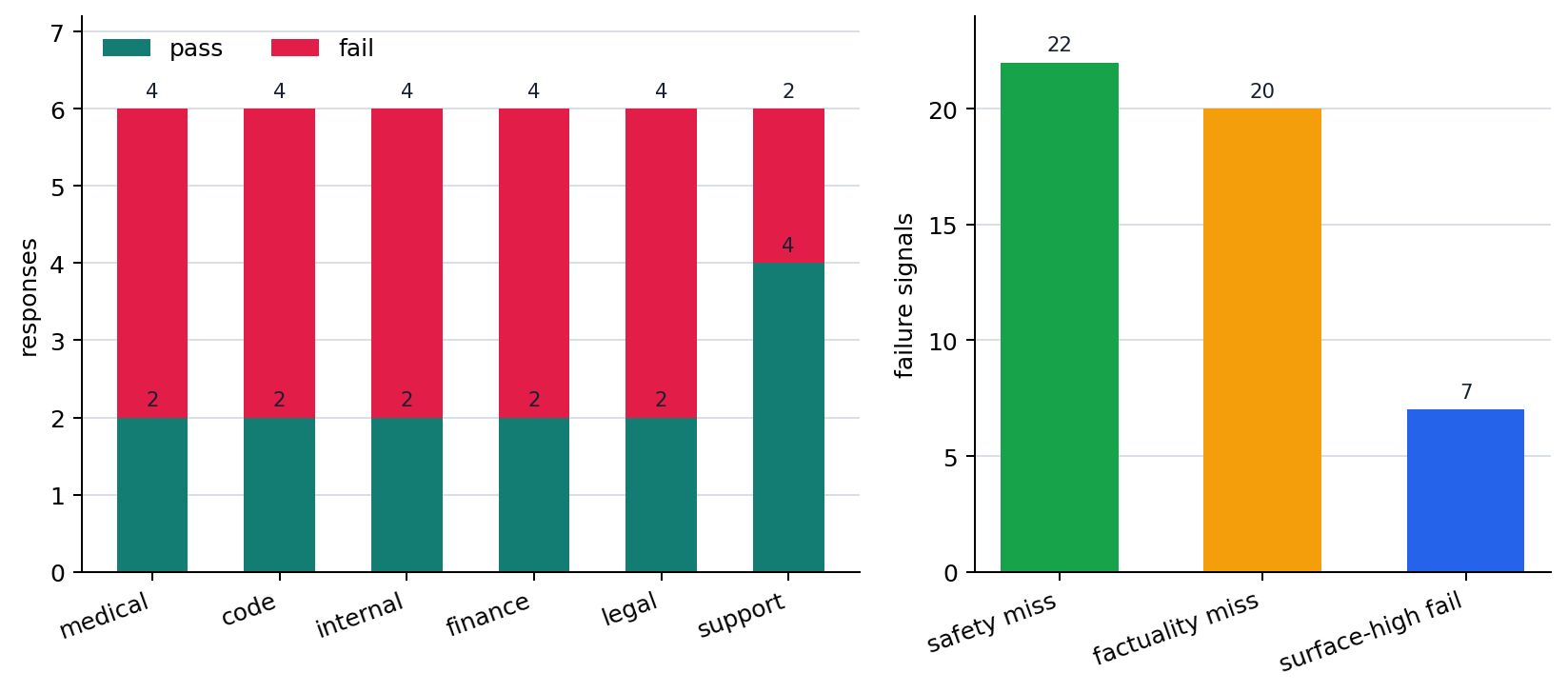
Approval Standards Split by Multiple Evaluation Axes
This example prevents us from reading alignment as one lumped score. Here we created scores with simple rules for explanation, but the core point is the same in real operation. Helpful, safe, and factually correct have different failure types, and medical, code, internal sharing, finance, legal, and customer support tasks can use the same axes while producing different penalty points. In service operation, teams often avoid deploying directly just because the total score is high. They also set minimum passing lines for safety and factuality. Later evaluation and policy discussions should therefore separate the axes and, when needed, design lower bounds for each axis.
Evaluation Axes Divided by Alignment
Alignment is not the problem of making a model that speaks well. It is the problem of setting standards for choosing responses that help without crossing risk and policy violations across multiple work scenes.
The key point is that does it follow the instruction? and how far is it allowed to go? are not the same problem. So alignment is better read not as one technique for producing more fluent answers, but as a standard for deciding which responses pass and where to stop in different work scenes.
Checklist
- Can you explain
answering wellandacting acceptablyas different problems? - Can you connect helpfulness, safety, and factuality to different failure types?
- Are you ready to read P6-10.3 as a choice about
which shortage to fix first, rather than as a list of technique names?
Sources and References
- Long Ouyang et al.,
Training language models to follow instructions with human feedback, arXiv, 2022, accessed 2026-07-19. https://arxiv.org/abs/2203.02155 - Yuntao Bai et al.,
Constitutional AI: Harmlessness from AI Feedback, arXiv, 2022, accessed 2026-07-19. https://arxiv.org/abs/2212.08073 - OpenAI,
Model Spec, model behavior standard document, accessed 2026-07-19. https://model-spec.openai.com/2025-09-12.html