P6-12.1 RAG That Attaches External Evidence Instead of Model Memory
Section ID:
P6-12.1Version:v2026.07.31
When recording a RAG request, separate question, retrieval_query, retrieved_evidence, evidence_source, answer_claim, and missing_evidence. This prevents an answer left to model memory and an answer supported by external evidence from looking like the same thing.
In P6-11.2, we saw that prompts alone have difficulty solving problems such as freshness, evidence guarantees, and executability. Then what matters is not only the answer sentence itself, but how to first change the materials that enter the answer.
How can we use external evidence together instead of relying only on model memory?
RAG (retrieval-augmented generation) is a structure where the model first retrieves related documents before making an answer, then generates based on those documents.
Standards for Attaching External Evidence Before Answering
RAG is a structure that changes the starting point of the answer from model memory to external document evidence. If prompt and instruction adjustment asked how should the model answer?, RAG changes the question to what should the model answer from? The actual combination flow is a problem where search results are attached to the input context and the answer is generated on top of them. The search storage structure and index prepare documents so they can be found again when needed.
Therefore, the core change here is not how well we refine the question sentence, but which document should be attached first before answering. Once this standard is in place, RAG can be read as a separate evidence-connection structure rather than an extension of prompting.
At first, it is enough to separate only two questions. Summarizing a meeting memo that is already available in three lines, or rewriting a classification result in table format, is usually a problem of adjusting how to answer with the same material. By contrast, asking about an internal policy changed today or usage for the current SDK version is a problem of choosing the answer material again from current documents. RAG becomes necessary in this second scene.
The impression a technique for attaching long documents to prompts should be replaced with a structure that changes the answer's starting point to external evidence documents. What should remain first here is a retrieval memo and evidence check record showing which documents were found as evidence candidates, why each document was judged relevant, and whether the final answer actually stood on document evidence.
Documents do not automatically attach themselves before an answer. Usually, document chunks are stored in a searchable form, and when a question arrives, related chunks are retrieved first. This storage structure can mix keyword search, ordinary databases, and vector databases, but LLM services often use vector databases to find semantically settle documents. This Section first holds the RAG structure of retrieve evidence before answering, and P6-13.1 looks at how that evidence is stored and retrieved with embeddings, original text, and metadata.
| Scene to distinguish first | Judgment to hold first | Why it must be separated first |
|---|---|---|
| Only the answer tone, table format, or summary style is unsatisfactory | It is likely a prompt-adjustment problem | The material is often already there and only the expression is drifting. |
| A policy changed today, the current SDK version, or an internal manual is needed | RAG is likely needed first | Without attaching latest and internal documents before answering, memory-dependent wrong answers are likely. |
| The document was seen, but calculation, lookup, or real execution matters more | RAG alone may not settle it | Reading a document and calculating a value or calling a system are different problems. |
| There are too many candidate documents, making the evidence unclear | Search quality and evidence records must be checked together | Even with RAG, trust is hard to verify if why a document was selected is not recorded. |
Why Model Memory Alone Is Not Enough
LLMs learn many patterns through pretraining and adjustment. But in real services, latest information and internal documents often do not update automatically. What RAG adds is a step that finds evidence documents before answering, so the answer's starting point moves from model memory to document evidence.
- A policy changed today must be reflected.
- The answer must be based on internal company documents.
- The explanation must use the latest product specifications.
- The answer must include actual sources.
These requirements are hard to satisfy reliably with only the memory already inside the model.
The reason is simple.
- Information after the training point is not automatically updated.
- Internal documents may not have been included in training at all.
- Even plausible-looking answers may not be connected to real evidence.
What Does RAG Try to Change?
The basic idea of RAG is very practical.
First find related documents, put those documents together, and generate an answer within that scope.
In other words, the structure changes from one where the model draws only on memory to one where:
- retrieval happens first
- the result is attached as context
- generation proceeds on top of it
For this reason, RAG is better understood not as a technology that makes the model smarter, but as a service structure that connects answer evidence to external materials.
From a service-structure perspective, if prompts handled how should we ask the model?, RAG handles what should the model answer from?
The difference becomes clearer when rewritten as operating questions.
| What to check first now | Prompt-stage question | RAG-stage question |
|---|---|---|
| Why the answer drifts | Is the requested format ambiguous? | Is the evidence document missing or outdated? |
| First focus to change | Should instructions, context, and examples be rewritten? | Should the document scope and latest documents to retrieve be attached first? |
| Result to check | Did format, length, and tone stabilize? | Were actual document conditions and numbers reflected in the answer? |
What Problems Does RAG Try to Reduce?
RAG is usually used to reduce the following problems.
- Missing latest information
- Missing internal documents
- Groundless general answers
- Difficulty tracing sources
RAG does not only trust model memory. It first brings in needed documents and narrows the evidence scope of the answer.
How Is It Different from Fine-Tuning?
This difference is very important.
| Method | Problem it mainly tries to solve |
|---|---|
| Fine-tuning | Adjusting specific formats, response tendencies, and domain fit |
| RAG | Connecting latest information, external evidence, and document-based responses |
For example:
- Matching answer format to company style may be more related to fine-tuning.
- Reflecting a refund policy that changed today is more directly related to RAG.
Without this distinction, users can easily misunderstand every problem as solvable with one fine-tuning run or one prompt.
The same request flow can be summarized again as follows.
- Prompt: Refines the way the question is asked.
- Fine-tuning: Better matches response tendencies and formats.
- RAG: Attaches external evidence before answering.
Separating one more point makes the flow into P6-12.2 and P6-12 more natural. External curricula often handle pretraining data preparation and retrieval document preparation together, but they are not the same task.
| Type of data preparation | What it first aligns | Where it connects here |
|---|---|---|
| Pretraining data preparation | Makes the model learn broad language patterns | P6-8.1, P6-8.2 |
| Retrieval document preparation | Makes documents retrievable again for the current question | P6-11, P6-12 |
So attaching RAG is more similar to prepare documents so they can be searched, then attach those documents before answering than to train the model broadly again.
When external RAG summaries and practice reports are read together, there is one more axis to separate. RAG is not a technique that starts only after a question arrives. It must be read together with the earlier content preparation stage.
| Before the question arrives | After the question arrives |
|---|---|
| Keep latest-version documents and separate old documents | Search for documents matching the current question |
| Split paragraphs neither too long nor too short | Attach retrieved paragraphs to the input context |
| Clean duplicate documents and attach metadata | Generate the answer within that paragraph scope |
In short, the first success condition for RAG is not only is the retrieval model smart?, but also are the documents already prepared in a searchable form?
Why It Is Often Used in Practice
In practice, answers whose evidence can be checked often matter more than answers that sound correct.
For example:
- Answers based on an internal wiki
- Customer support based on product manuals
- Search responses based on legal or policy documents
- Developer assistance based on technical documents
In these cases, RAG is practical because it changes the path to evidence rather than the model itself.
The important line here is this.
In practice, an answer with traceable evidence often matters more than a polished answer.
RAG Is Not Universal Either
But RAG should not be exaggerated either.
Having RAG does not automatically guarantee that:
- the most relevant document is always found
- the found document is always read correctly
- citations are always correct
- search results are sufficient
In other words, RAG makes the system handle both a retrieval problem and a generation problem, but it does not automatically solve both.
A safer explanation is the following.
RAG is a strong structure that connects answer evidence to external materials, but retrieval quality and generation quality must be checked separately.
Drawn Very Simply
flowchart TD
  A["user question"]
  B["retrieve relevant documents"]
  C["attach documents to context"]
  D["generate grounded answer"]

  A --> B
  B --> C
  C --> D
The key of this diagram is that retrieval comes first, and generation follows.
Cases and Examples
Case 1. Internal Policy Question Answering
If the question is How did the travel-expense reimbursement standard change?, it is easy to answer from a remembered notice or previous standard. Internal policies are still documents read by people, so it is easy to expect that the model knows them like general knowledge. But internal policies are revised often, and old standards can differ from today's standards, so memory-dependent answers easily become wrong guidance. For example, if there was no transportation-cost cap last year but a cap exists this year, the answer is wrong even if the tone is natural. The more dangerous point is that this kind of answer can be copied inside the organization as a sentence that looks official.
RAG first searches the latest internal policy document, finds currently effective clauses, attaches that paragraph as context, and then makes the answer. The structural change here is that the starting point moves from bring out the remembered answer to check the currently valid document first. The misunderstanding to correct is the expectation that if the explanation is natural, it is enough for now. The result to check in this case is whether the actual latest policy paragraph is attached as answer evidence before the natural explanation, and whether that paragraph alone lets us recheck the currently effective standard.
Case 2. Product Manual-Based Support
Consider a customer-support chatbot that answers product usage questions. It is easy to feel that basic questions are handled sufficiently if a few FAQs and common answer templates are organized well. Customer questions tend to repeat, so reusing an answer once made can look safe. But menu names and setting locations can change by version, so a template may be natural while its content quickly becomes old. For example, if the old Advanced Settings menu has moved to Preferences in the current version, a memory-based answer sends the customer to the wrong screen. The user then experiences the failure, The answer was kind, but why is it different from the actual screen?
RAG first finds related documents from the latest manual and FAQ, attaches the current-version explanation, and then composes the answer. As a result, answer quality can be managed first by consistency with the current document, before tone. The misunderstanding to correct here is the feeling that for frequently asked questions, memory-based templates are enough. The result to check in this case is not whether the template is natural, but whether the current version's menu and procedure match actual documents, and whether each step of the answer also corresponds to the real screen path.
Case 3. Developer Documentation Search
Imagine a developer asking, Where do I put the authentication header in the current SDK version? It is easy to think the model can answer immediately because it knows a lot of general API knowledge. For syntax questions, remembered examples can look faster than search. But if the model remembers old-version syntax, an answer that looks plausible can immediately fail in real code. For example, if it repeats an old Authorization example while the current version now takes a separate auth object, the copied code fails immediately. This failure is not just a wrong answer. It leads to debugging time, lower trust, and spread of incorrect sample code.
What should be checked first is not the model's general knowledge, but the version document being used now. RAG reduces this version-mismatch risk by first retrieving current API documentation and example pages, attaching them as context, and then making the answer. The key is not fluency of the generated sentence, but whether the retrieval stage accurately picks the current document. The misunderstanding to correct here is the attitude that if the code looks plausible, we can copy and try it first. The result to check in this case is not whether the answer looks plausible, but whether the current SDK document and code example are attached together as evidence, and whether the same code can be reproduced by following only that evidence.
The three cases can be grouped again as operating check standards.
| Situation | Evidence that must be attached first | Wrong answer when evidence is missing |
|---|---|---|
| Internal policy | Latest policy notice, currently effective clause | Naturally repeats an old rule |
| Product support | Current-version manual path, latest FAQ | Guides with outdated menu names and procedures |
| Developer documentation | Current SDK/API version document, official example | Mixes old option names or code patterns into the answer |
The same content can be read again through an evidence-first structure as follows.
flowchart TD
  A["user question"]
  B{"answer from memory first?"}

  A --> B
  B -->|yes| D["old or generic answer risk"]
  B -->|no, retrieve first| E["current document attached"]
  E --> F["grounded answer"]
The key is not generate immediately after the question, but retrieve evidence first after the question.
Scenes Where Evidence Connection Is Needed
The most common confusion when first reading RAG is to see only that the answer is wrong and immediately make the prompt longer. But in the three cases in this Section, what should be checked before sentence expression is was the current document actually attached before answering?
| If this scene appears | What to check first | Why this order matters |
|---|---|---|
| The answer tone or table format is unsatisfactory, but the facts themselves are already correct | Is this a problem of adding latest documents, or format adjustment? | If the evidence is already correct, it is better to first separate prompting or adjustment-layer problems rather than add more RAG. |
| The answer is natural, but different from the policy changed today | Was the latest policy document retrieved first? | Without latest documents, careful wording can still repeat old answers. |
| The menu explanation is kind, but different from the actual screen path | Was the current-version manual attached as evidence? | Current-version document consistency must be correct before templates. |
| The code example looks plausible, but fails in the current SDK | Were the current-version official document and example attached? | Current-version evidence must be correct before general knowledge for copyable answers. |
The same standard can be read as shorter work questions.
| If this suspicion appears | First question to ask |
|---|---|
The answer format is lacking, but the facts look right | Do we need new document evidence, or tone and format adjustment? |
The answer is smooth, but somehow looks old | Which latest document is the answer based on? |
The explanation is kind, but not aligned with the actual screen | Was the current manual path actually attached? |
The code looks plausible, but does not run | Were the official example and current API document retrieved together? |
The first standard to learn is simple. RAG is not a trick for writing questions better, but a structure that fixes what evidence to attach before answering at the system stage.
Exercise and Example
The goal of the example is not to implement a real vector database or LLM service. It is to check the minimal RAG behavior of question -> choose related documents with a retrieval model -> answer based on those documents. Refund policy, product manual, and SDK documentation questions are run together, and we compare what changes between answering without retrieval and answering after attaching documents selected by a retrieval model.
Users can ask about latest policies, current-version product screens, and current SDK usage. Old standards or general knowledge can remain in model memory, and without finding related documents first, natural wrong answers can appear. So this example uses scikit-learn's TfidfVectorizer like a very small retrieval model. It is not a real embedding model, but the flow of converting questions and documents into vectors and choosing settle documents can be checked by direct execution. In Korean, short sentences are more stable with character n-grams than whitespace words. In English too, this example keeps the same character n-gram setting so that the experiment structure stays aligned with the source.
The example below uses two CSV files as input.
- Question list: p6-11-rag-need-questions-en.csv
- Document candidates: p6-11-rag-need-documents-en.csv
One row in the question list means one user question. The core columns are case_id, question, memory_answer, and current_signal. memory_answer is an old answer that could appear when relying only on model memory without retrieval, and current_signal is an observation clue for checking whether the answer mentions latest evidence. This clue is not an answer key, so we also check the topic match, version status, similarity, and number of evidence documents in the retrieved documents.
One row in the document candidates is one document chunk to retrieve. The core columns are title, text, version_status, and source_type. Rows whose version_status is current are current evidence documents, rows marked old are archived documents, and rows marked related are auxiliary documents that are related but hard to use as the core evidence for the final answer.
When reading this example, it is better to first hold what should be checked in a table.
| Check item | Why it is needed |
|---|---|
Whether the memory answer contains the latest signal | Check what is missed when answering without retrieval |
| Whether the first document selected by the retrieval model matches the question topic | Check whether an evidence-selection stage actually appears before answering |
| Whether the first document selected by the retrieval model is current | Check that old documents do not enter as evidence for the current answer |
| Whether the RAG answer contains the latest signal | Auxiliary check that the selected document was actually reflected in the answer |
| Whether a similarity score remains together | Track why a certain document was attached first |
The key point to check in the code is that RAG is not a technology that directly fixes the answer sentence, but a structure that first makes the retrieval model choose evidence documents before answering.
1 2 3 4 5 6 7 8 9 10 11 12 13 14 15 16 17 18 19 20 21 22 23 24 25 26 27 28 29 30 31 32 33 34 35 36 37 38 39 40 41 42 43 44 45 46 47 48 49 50 51 52 53 54 55 56 57 58 59 60 61 62 63 64 65 66 67 68 69 70 71 72 73 74 75 76 77 78 79 80 81 82 83 84 85 86 87 88 89 90 91 92 93 94 95 96 97 98 99 100 101 102 103 104 105 106 107 108 109 110 111 112 113 114 115 116 117 118 119 120 121 122 123 124 125 126 127 128 | |
When this code is run from the repository root, it prints as follows.
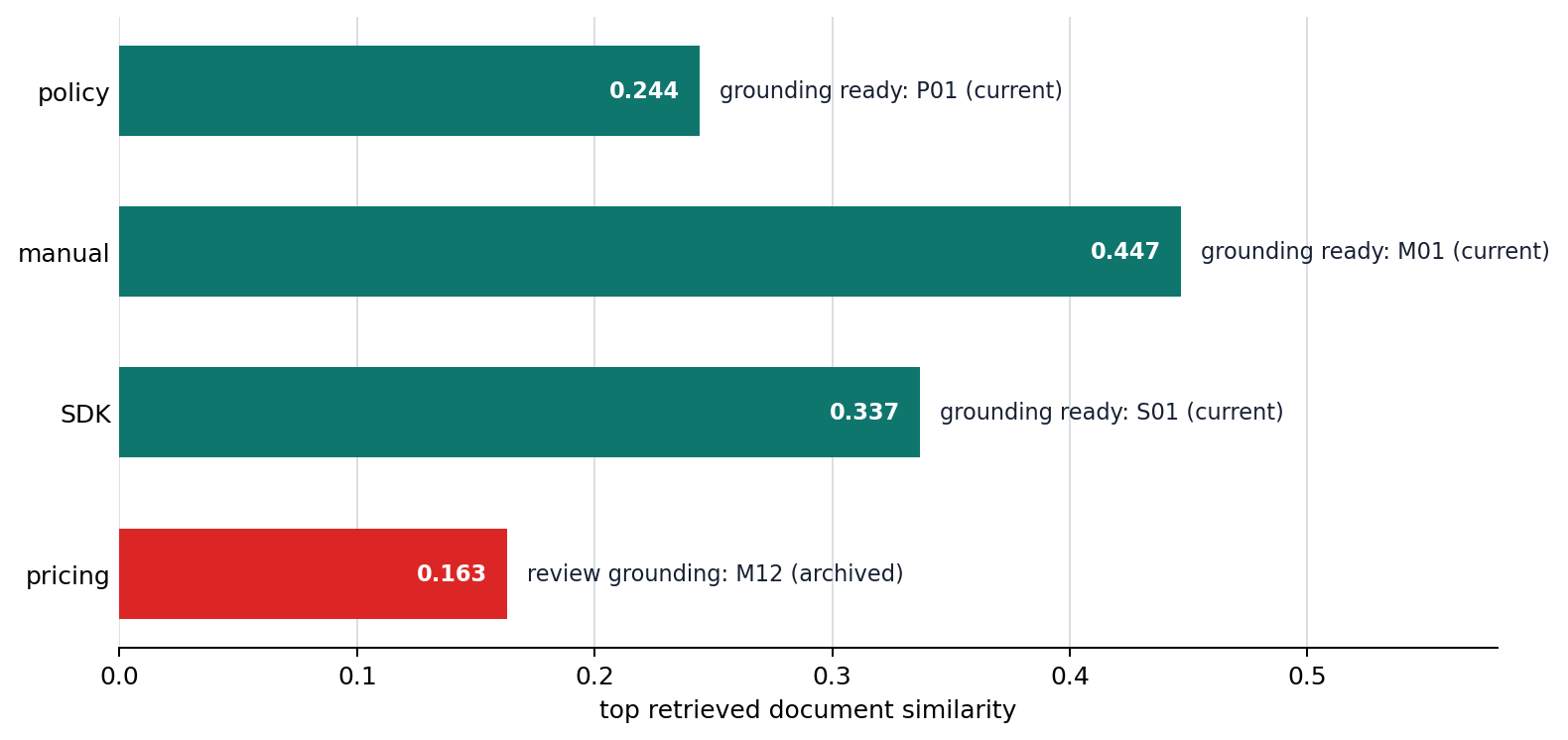
The first points to notice are that memory_update_mention_count is 0 and grounding_ready_count is 3. If the model answers only from memory without retrieval, all four questions miss the latest signals. RAG, however, first attaches a current document matching the question topic for the policy, manual, and SDK questions, then recovers the latest signal in the answer. By contrast, the pricing question has only an archived pricing candidate, so even if two documents are attached, top_doc_is_current and answer_mentions_expected_update remain false. In short, grounding_ready is not the number of retrieved documents. It checks whether a current document matching the question topic was actually connected to the answer.
So the results to check in this example are twofold.
- The system does not answer immediately from the question alone. The retrieval model first attaches related documents selected by search, then moves to generation.
- RAG quality must be checked not only by the answer sentence, but also by
whether a current document matching the question topic was retrieved,whether similarity scores and evidence titles remain, andwhether absence of evidence remains as a failure.
Readers can directly adjust the example in the following ways.
- Change expressions in the question CSV and see how retrieved documents and similarity scores change.
- Add archive documents or unrelated documents to the document CSV and check whether the current document still remains at the top.
- Add a current document matching the
pricingquestion and see howgrounding_readychanges. - Change
top_kfrom 1 to 3 and see how the evidence document bundle changes. - Change
answer_with_ragso that it returns not only document titles but also document IDs and version status.
Changed Answer Standards in an Evidence-First Structure
The previous example does not implement all of RAG. It shows the shortest scene that the structure is not make the answer first and decorate it with evidence, but attach evidence first and then make the answer. The core to read here is which evidence step must necessarily happen right before the answer, more than the answer sentence itself. It is also important that this principle repeats across domains such as policies, manuals, and SDKs.
The core to read in this example is as follows.
- Do not answer immediately just because there is a question.
- Find documents first.
- Attach those documents and then answer.
In other words, the core change of RAG is in the evidence step before answering, more than in the answer sentence.
The difference appears more naturally when we look at similarities for the top retrieved documents. Policy, manual, and SDK questions place current documents matching the question topic near the top and create answers from those documents. By contrast, the pricing question places low-similarity documents from other topics near the top, so the mere fact that documents were retrieved does not mean evidence connection is ready. The change to read here is therefore not that the answer sentence became slightly better, but that we need to separately record which document was selected before answering and with what level of relevance. The core of RAG is not making the model remember more, but retrieving current related documents before answering and making the model speak from them.
The more important point is that speaking plausibly and answering with attached evidence are not the same problem. So RAG is better read not as a device that makes the model smarter, but as the first connection structure that compensates for prompt limits structurally by retrieving evidence documents before answering.
Checklist
- Can you explain RAG as a
structure that attaches current documents before answering? - Can you distinguish what prompts, fine-tuning, and RAG each change first?
- Are you ready to read P6-12.2 not as
why attach documents, but ashow attached documents actually lead to answers?
Sources and References
- Patrick Lewis et al., Retrieval-Augmented Generation for Knowledge-Intensive NLP Tasks, NeurIPS, 2020, accessed 2026-07-19.
- OpenAI, Retrieval, OpenAI API Docs, accessed 2026-07-19.
- OpenAI, File search, OpenAI API Docs, accessed 2026-07-19.
- scikit-learn developers, TfidfVectorizer, scikit-learn documentation, accessed 2026-07-22.
- scikit-learn developers, Cosine similarity, scikit-learn documentation, accessed 2026-07-22.