P6-14.1 Tool Use That Hands Lookup, Computation, and Execution Outside the Model
Section ID:
P6-14.1Version:v2026.07.31
Record a tool-use request by separating model_request, tool_name, tool_input, tool_output, execution_status, and model_summary. Keeping this distinction separates the part where the model generated an explanation from the part where lookup, calculation, or execution actually happened in the tool.
In P6-13.2, we saw that an index in vector retrieval creates a balance between retrieval speed and candidate quality. But retrieval is only one way to connect to the outside world. Now a broader question appears.
What should we do when the model must go beyond reading documents and actually call an external function?
Tool use is a structure in which a model does not stop at generating text, but connects to external functions such as calculators, search tools, databases, and APIs.
Requests that need execution connection
The core questions are these.
- Why is tool use needed?
- How is RAG different from tool use?
- In what situations is a tool call more appropriate than an answer from the model alone?
The first issue to settle is reading tool use as an execution structure in which the model is connected to external functions, and grasping how it differs from RAG's document reading.
Here we first separate requests that only need document reading from requests that settle only when an external function is actually called. Splitting an execution request into a name and arguments is handled in P6-14.2, and chaining several executions is handled separately in P6-15.
Tool use does not mean the model suddenly gains execution ability. It means the application connects the model with external functions. If RAG attached external documents as evidence, tool use moves one step further by actually calling external functions and bringing back results. How to make the call name and arguments into a verifiable shape is the topic of P6-14.2, and how to continue multiple calls in sequence is the topic of P6-15.
Instead of memorizing many tool names, first read tool use through three questions: is the needed work document reading or actual execution, what must be looked up, computed, or executed, and what call structure will carry the execution result.
The first check at this stage is simple. We need to separate whether the answer settles with a document explanation, whether it needs a current state lookup or computation result, or whether it needs an external-world action such as reservation or modification. Once this distinction is in place, the next Section's function-call structure can be read not as a product feature name, but as a form that stabilizes execution requests.
Separating explanation generation from actual execution connection
- You can explain tool use at an introductory level.
- You can describe the difference between RAG and tool use.
- You can explain why tools are needed for computation, lookup, and execution.
- You can explain why execution requests need to be turned into a function-calling structure.
The first scenes to separate can be summarized like this.
| First obstacle | First question to ask | Why this question comes first |
|---|---|---|
| The relevant rule was read, but the current state value is still unknown. | Is live lookup needed before document reading? | Without the current value, the answer may be fluent but not match the real state. |
| An explanation is possible, but numeric accuracy is central. | Should a computation tool result be fetched instead of an estimate? | Computation needs numeric correctness before tone; guessed answers can quickly drift. |
| The answer settles only after an execution result exists, but no action has happened yet. | Does the question end only after calling an actual execution tool? | File edits, reservations, and sends are not completed by explanation alone. |
| It is unclear whether to read documents, call a tool, or use both. | Is the needed object evidence, a lookup value, or an execution result? | If reading and execution are blurred, we can choose RAG for a question that needs tool use, or the reverse. |
Using this table, tool use is easier to read not as a list of tool names, but as the point where document reading moves into actual lookup, computation, and execution.
Why tool use is needed
LLMs are strong at text generation, but some tasks are hard or risky to handle with words alone: exact computation, lookup, and execution. What tool use adds is an external function-call step, so the structure changes from guessing an answer to fetching an actual result.
- Exact calculation
- Database lookup
- Calendar reservation
- Email sending
- File reading and editing
- Live API calls
These tasks are different from simply making a sentence that looks like an answer. They affect the external world or need a verifiable result.
Tool use usually appears for these purposes.
- To compensate for the model's weak arithmetic ability
- To access live information
- To connect the answer to actual system behavior
From the service-structure point of view, if RAG attaches evidence document reading, tool use attaches actual function execution.
How it differs from RAG
We need to separate this difference first so that we do not choose the wrong structure between adding document evidence and executing an actual function.
| Structure | Central role |
|---|---|
| RAG | Finds related documents and attaches them as answer evidence. |
| Tool use | Calls external functions to fetch actual results or execute actions. |
For example:
- Searching documents and explaining them is more similar to RAG.
- Calling an exchange-rate API to fetch the current value is more similar to tool use.
- Getting an exact total from a calculator is also more similar to tool use.
In short, RAG is mostly centered on read, while tool use is a broader structure that includes query, compute, and act.
Compressed to the main flow of Part 6, the difference is this.
| Structure | What is attached first | Central question | Representative result |
|---|---|---|---|
| RAG | Related documents | What should ground the answer? | An answer with document evidence |
| Tool use | External function call | What should be actually looked up or executed? | Computed value, lookup value, execution result |
| Agent | Multiple connected steps | In what order should work continue? | A workflow that updates state |
The core point of this table is that reading documents, executing functions, and continuing multiple steps are different levels. RAG can have tool use on top of it, and an AI agent can then tie the two into one goal flow.
Up to this point, we are still reading which external function should be attached for one request. For example, summarize our internal refund policy is more similar to a RAG problem that first finds document evidence. Use today's exchange rate to convert 300 dollars to KRW is more similar to a tool-use problem that needs a current value lookup and computation tool. A request such as find and reserve an available meeting room tomorrow connects lookup and execution, so it is revisited later in the AI agent structure.
In this Section, we settle the move from what should be read to what should actually be looked up, computed, or executed. How to stabilize that execution request as a name and argument structure continues in P6-14.2's function calling, and how to chain multiple executions continues in P6-14's AI agent structure.
Does the model directly use tools?
Here people often misunderstand the model as calling the API by itself. The safer explanation is this.
The model usually produces output about which tool may be needed, and the application or execution environment performs the actual call.
Tool use is more similar to a cooperative structure:
- the model proposes a request structure
- the system interprets that request
- the system calls the actual tool
- the result is connected back to the model or the user
We need to separate what execution the model proposes from what the system actually performs, so that failures can be divided into judgment-stage problems and execution-stage problems.
When it is especially useful
Tool use is practical in situations such as these.
- Numeric calculation must be exact.
- A live external-system lookup is needed.
- Files or data must be manipulated.
- Execution results must be summarized again.
Tool use connects the model's ability to speak well with the system's ability to actually do things.
The same request flow can be summarized again.
- Prompting: adjust how the question is asked
- RAG: attach evidence documents before answering
- Tool use: call actual functions before or during the answer
Tool use is not a universal solution
Having tool use does not automatically guarantee:
- always choosing the correct tool
- constructing all required arguments accurately
- blocking unauthorized work automatically
- correcting all wrong execution results by itself
Tool use expands capability, but it also introduces these problems.
- Permission
- Approval
- Error handling
- Trace
- Reproducibility
These problems continue into later chapters on agents and harness structures.
A minimal diagram
flowchart TD
  A["user request"]
  B["model decides tool is needed"]
  C["application calls external tool"]
  D["tool result returns"]
  E["model or app produces final answer"]

  A --> B
  B --> C
  C --> D
  D --> E
Execution Requests That Explanation Alone Cannot Settle
Case 1. Calculator tool
Suppose a user asks, What is the final price after applying a 13.7% discount three times in a row? It is easy to feel that a model good at explaining will also be similarly good at calculating. But in a longer calculation process, small arithmetic errors can appear in intermediate multiplication or rounding. For example, if the model simply adds the discount rates, the explanation may sound plausible while the result is immediately wrong.
What matters here is not a more plausible explanation, but an exact computation result. If the calculation is slightly wrong, the discount amount, tax, and final billed amount can all drift. The standard changes from first asking does it explain well to first asking was the exact calculation checked with an external calculator. With a tool-use structure, the model can call a calculator tool and explain the returned result instead of guessing the number itself. The result to check in this case is not tone, but whether the final number and intermediate calculation match.
Even for similar questions, the judgment standard changes like this.
| Question scene | Mistake that can arise when reading only the explanation | What to check first from the tool-use view |
|---|---|---|
| Repeated discount calculation | A step-by-step explanation can make the result seem right. | Do intermediate multiplication and rounding match the actual calculator result? |
| Final price with tax | A plausible final number can be accepted too easily. | Do pre-tax value, post-tax value, and application order all match the calculator result? |
| Exchange rate, discount, and fee mixed together | Long reasoning can feel more trustworthy. | Are each step's numbers verified by an external computation result, not only the final number? |
The misunderstanding to move past in this table is the expectation that if the explanation looks good, the calculation is probably right. The point of the calculator-tool case is to separate explanation and calculation, and to verify the calculation side against a separate execution result.
Case 2. Calendar lookup
Imagine a user asking, Is there an available meeting room tomorrow afternoon? It is natural to first think of related guidance documents or general rules, but this question is not solved by retrieving a policy document. It settles only by looking up the current state of the calendar system. For example, reservation rules may exist in a document, but whether the third-floor meeting room is currently available lives in calendar state, not in the document.
The first distinction to make is not is document knowledge needed, but is a live state value needed. If the system answers only with general rules without a lookup, the user may believe a room is available when it is already booked. If the calendar tool is queried, it can return a current result such as Third-floor small meeting room A is available, while B is booked from 15:00 to 16:00. The standard changes from does it know the rule to did it actually look up the current state. With tool use, the model can query the calendar or reservation system and answer from that result. The result to check is whether the answer returns actual available rooms or unavailable status as of the current point, not a summary of general rules.
Reduced to an operational memo, the difference looks like this.
| User question | Can it settle with document explanation only? | What actually needs to be looked up |
|---|---|---|
What are the meeting-room reservation rules? | Mostly yes | Rules document |
Is a third-floor meeting room available tomorrow afternoon? | No | Current calendar reservation state |
Reserve room A as soon as it becomes available. | Even more than explanation is needed | State lookup + execution tool |
The standard to hold in this case is not does the model know related information, but is the needed information inside a document or inside system state. Calendar lookup shows that tool-use need is decided at exactly this branch.
Case 3. File editing
Suppose a coding assistant receives the request, Rename this function according to the new convention. People sometimes think that explaining how to change it should be enough, but the actual file does not change from the explanation. Also, renaming one function can require finding and updating the declaration, call sites, and tests together. If only the declaration changes and the test call is missed, the answer may look plausible while the repository breaks immediately.
In this case, what is needed is not only explanation ability, but execution ability that reads, edits, and saves files. If only an explanation is left without the actual edit, the user must do manual work again, and omissions become more likely. The standard changes from does it explain how to modify to does it actually change the file state and related locations. With tool use, the model can call actual file-operation tools rather than stop at a modification proposal. The result to check is not the explanatory paragraph, but whether the declaration, call sites, and tests were updated together and the repository still works.
The core point of this diagram is that the model does not finish alone. There is a round trip with an external system.
The three cases can be grouped again by execution judgment.
| Situation | What model explanation alone lacks | What must actually be checked or changed |
|---|---|---|
| Calculator tool | Plausibly speaking a number | Exact computation result |
| Calendar lookup | Explaining reservation rules | Current schedule state |
| File editing | Explaining how to modify | Actual file content and linked locations |
The same content can be reread as an execution-delegation structure.
flowchart LR
  A["user request"]
  B["model decides whether tool is needed"]
  C["tool call plan<br/>name + arguments"]
  D["execution environment runs tool"]
  E["tool result"]
  F["final answer"]

  A --> B
  B --> C --> D --> E --> F
The key point is that an execution preparation structure appears before the answer.
Scenes that need execution connection
The most common confusion when first reading tool use is treating every case of external information is needed as the same problem. In practice, we first need to separate whether a document can be read, whether a current state must be queried, or whether something must actually be changed.
| If this scene appears | Check first | Why this separation matters |
|---|---|---|
| It seems enough to explain a rule or manual. | Is the question settled by document evidence only? | If live lookup or execution is unnecessary, RAG is usually the first fit. |
| Numeric correctness such as discount, tax, or exchange rate changes the result. | Should an actual calculation value be fetched instead of an estimated sentence? | Computation can be wrong despite fluent explanation, so it should be checked against external computation. |
| Time-point values such as an available room or current exchange rate matter. | Is live state lookup needed? | The starting point of the answer is current system value, not document explanation. |
| World state must change, such as editing a file or creating a reservation. | Is actual execution and approval structure needed? | Explanation does not complete the work, and permission and failure handling follow. |
The same standard can be turned into shorter practical questions.
| If you suspect this | First question to ask |
|---|---|
Can this be answered by reading documents only? | Is the needed object rule explanation or current value lookup? |
The explanation is plausible, but I worry the number is wrong. | Should a computation-tool result be fetched first instead of an estimate? |
The answer is possible, but hard to trust. | Should actual lookup or computation values replace guessed sentences? |
The explanation is enough, but the work is not done. | Is an execution stage needed to change a file, reservation, or state? |
The standard to learn first is simple. Tool use is not a way to attach more external information. It is a connection structure that actually retrieves or produces results outside document reading: lookup, computation, and execution.
Checking Request Branches Through Execution Records
The goal of this example is not to connect a real external API. It is to visually confirm that user request, tool-need judgment, tool-call plan, tool execution result, and final answer are different stages. If we look at only one request, it is easy to stop at exchange-rate lookup = tool needed. So we run several requests together and see that some settle with explanation only, while others split into lookup, computation, or execution delegation.
Some requests need a live lookup and therefore need a tool. Some are general explanations and can be answered without a tool. Some change external state, such as making a reservation, so they should stop in an approval-pending state instead of being executed immediately. Therefore, we first judge is a tool needed; even when a tool is needed, we separate lookup, computation, execution, and whether execution is allowed.
The example below uses a user-request CSV, a local LLM route proposal, an application guard's final judgment, tool-returned lookup and computation results, and an approval-pending state for execution. If ollama is installed and the model specified by AIBOOK_OLLAMA_MODEL is available, the model first proposes a request type. The prompt sent to the model and model_request_en are kept in English. This improves small local model routing stability and also makes it easier to keep the same execution standard across Korean, English, and Chinese translations. Even if the local model is unavailable or its output is unstable, the application guard finalizes the execution route, so the same code can run. In the output, we inspect the model suggestion, whether the guard corrected it, the tool-call structure, execution result, and final answer for each request.
The input CSV p6-13-1-tool-use-requests-en.csv contains 18 requests. user_request_en is the English request shown to the reader, and model_request_en is the English request used for model routing. request_signal is the minimal signal checked by the application guard before execution. This signal is not an answer key for the model, but a simplified input representing missing information, state change, or computation need that real service code must check before execution.
The first inspection items in this example are these.
| Inspection item | Why it is needed |
|---|---|
model_route | Check what execution direction the model first proposed. |
guard_changed_model_route | Check whether the application corrected the model proposal before execution. |
needs_tool | Decide which requests need to move into an execution stage. |
tool_selected | Check whether the required function was selected correctly. |
tool_result_used | Check whether the actual execution result was reflected in the final answer. |
skipped_tool_when_not_needed | Check that unnecessary tools are not called for requests that do not need one. |
approval_required | Check that external state changes stop instead of being executed immediately. |
missing_info | Check that missing required information is returned to the user before tool execution. |
The key point in the code is that the system does not execute immediately from the model proposal alone. It goes through a pre-execution guard that finalizes whether a call is needed and whether approval is required. If a call is made, the execution result must appear in the final answer.
1 2 3 4 5 6 7 8 9 10 11 12 13 14 15 16 17 18 19 20 21 22 23 24 25 26 27 28 29 30 31 32 33 34 35 36 37 38 39 40 41 42 43 44 45 46 47 48 49 50 51 52 53 54 55 56 57 58 59 60 61 62 63 64 65 66 67 68 69 70 71 72 73 74 75 76 77 78 79 80 81 82 83 84 85 86 87 88 89 90 91 92 93 94 95 96 97 98 99 100 101 102 103 104 105 106 107 108 109 110 111 112 113 114 115 116 117 118 119 120 121 122 123 124 125 126 127 128 129 130 131 132 133 134 135 136 137 138 139 140 141 142 143 144 145 146 147 148 149 150 151 152 153 154 155 156 157 158 159 160 161 162 163 164 165 166 167 168 169 170 171 172 173 174 175 176 177 178 179 180 181 182 183 184 185 186 187 188 189 190 191 192 193 194 195 196 197 198 199 200 201 202 203 204 205 206 207 208 209 210 211 212 213 214 215 216 217 218 219 220 221 222 223 224 225 226 227 228 229 230 231 232 233 234 235 236 237 238 239 240 241 242 243 244 245 246 247 248 249 250 251 252 253 254 255 256 257 258 259 260 261 262 263 264 265 266 267 268 269 270 271 272 273 274 275 276 277 278 279 280 281 282 283 284 285 286 287 288 289 290 291 292 | |
Example output can be read like this. The output below reflects an environment where the Ollama client exists but no local model server is running; the application guard still finalizes the route and makes the example reproducible.
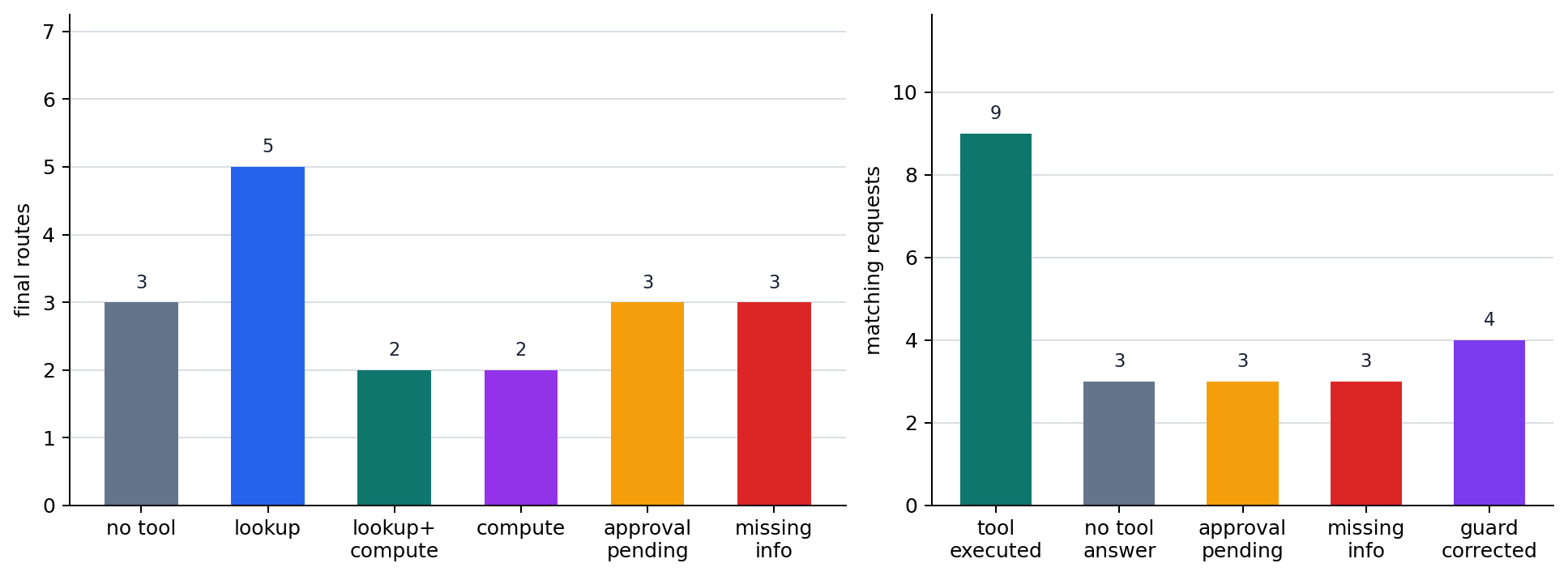
The first point to notice is that the final route is not decided by the model output alone. The model proposal can be absent or unstable, but the application guard still decides no_tool, lookup, lookup_compute, compute, action_pending, and needs_info before execution. The guard is not a decorative fallback. It is the structure that prevents missing information, approval-requiring state changes, and needless tool calls from moving straight into execution.
So this example should leave three results.
- Tool use begins by separating requests that can be answered with explanation only from requests that need lookup, computation, or execution.
- A model suggestion is not the same as execution; the application guard must verify the route before a tool is called.
- If a tool is called, the final answer should use the returned result, while state-changing actions should remain approval pending.
The reader can directly adjust the example in these ways.
- Change
request_signalfor one row and see how the guard route changes. - Set
AIBOOK_OLLAMA_MODELto a local model and comparemodel_routewith the guard route. - Add one more
state_changerequest and check that it stops withapproval_required. - Expand
execute_toolwith another fixed tool result and see whethertool_result_usedcatches it in the final answer.
What changes when actual execution is connected
The example above is not a real tool integration. It is a minimal structure showing that requests must be separated into explanation, lookup, computation, execution, missing information, and approval. The key point is that the model's tool suggestion is only a proposal. The application must decide before execution whether the request has enough information, whether it changes external state, and whether a result can be safely returned.
The chart below rereads the same result as a decision check. Requests that need no tool should skip execution, lookup and computation requests should use returned values, and state-changing requests should remain approval pending. This is the point where tool use becomes a system structure rather than a prompt trick.
What tool use connects
Tool use is a structure that connects model-generated text with the outside world. The model may propose a tool call, but the application or execution environment performs the actual call and returns a result.
This matters because:
- it separates document reading from actual lookup, computation, and execution
- it prepares us to read function calling as a structured request format in P6-14.2
- it prepares us to read agents as multi-step execution flows in P6-14
The view established here continues into later sections.
- P6-14.2 function calling: how to stabilize tool name and arguments
- P6-15.1 and P6-15.2 agents: how to connect multiple tool calls over time
- P6-16 evaluation and P6-17 operation: how to inspect execution results, approvals, failures, and traces
Checklist
- You should be able to explain tool use as a structure for actual lookup, computation, and execution outside the model.
- You should be able to distinguish RAG's document reading from tool use's function execution.
- You should be able to say why state-changing actions need approval and why missing information should stop execution.
Sources and references
- OpenAI, Function calling, OpenAI API Docs, accessed: 2026-07-19.
- OpenAI, Tools, OpenAI API Docs, accessed: 2026-07-19.
- OpenAI, File search, OpenAI API Docs, accessed: 2026-07-19.