P6-16.2 Harnesses That Wrap Execution Records and Reproducible Environments
Section ID:
P6-16.2Version:v2026.07.31
Leave harness records as input_snapshot, tool_call_log, environment_state, approval_state, output_snapshot, and replay_note. Then you can check again why the same run flowed that way instead of looking only at the final answer.
In P6-16.1, we saw that MCP is an interface viewpoint that makes connections between models, external tools, and data more consistent. But even if the connection format is organized, it is hard to explain the cause of failure or the effect of improvement again unless the execution flow remains as a record. Now we need to look at the structure that wraps AI agent execution, leaves logs and evaluation inputs, and manages the flow so it can be repeated.
A harness is similar to an execution environment or operational device that wraps an agent or model run and manages inputs, tool calls, results, logs, evaluation inputs, and reproduction information.
A structure that wraps execution records
The first issue to settle is what form should preserve trace, replay information, and approval records. Quality checking is the problem of reading the remaining records as pass criteria, and operational constraints and failure handling are the problem of moving that judgment into real service control.
Here, we read a harness not as the name of a single product, but as a wrapping structure that controls, records, and evaluates execution.
If the previous sections were about creating connection and execution structures, a harness explains why the trace, log, replay information, and approval record left by that execution become inputs to evaluation criteria. A good execution record is not an operational appendix. It is an input that supports the question by what standard should we judge this as acceptable.
A harness fixes three axes. First, what should remain as a trace and replay information? Second, why does this record become evaluation input? Third, what do MCP and harnesses each handle among connection and execution management? The core viewpoint changes from was the connection done well to can we explain and compare the execution that used that connection again.
The minimum difference among MCP, harnesses, evaluation, and operations can be fixed like this.
| Current level | Core question | What it leads to next |
|---|---|---|
| MCP | What should be connected, and in what shared format? | What trace and replay information should be left for the execution that used the connection? |
| Harness | How should execution be wrapped and recorded? | By what quality criteria should the remaining record be read? |
| Evaluation | Which executions should pass as acceptable? | How should passed executions be operated through cost, latency, and failure control? |
| Operations | Which failures should stop where, and how should they recover? | How should that judgment remain in request flow and run records? |
Distinguishing execution output from reproducible records
Rather than memorizing harness as a tool name, it is safer to ask which failure cannot be narrowed down again if a certain record is missing. Once this viewpoint is set, a harness can be read not as a simple log store, but as an operational device that makes tool executions connected by MCP explainable again through records such as trace, log, eval, and replay.
| First visible blockage | Record to keep first | Why this record is needed first |
|---|---|---|
| Failure is visible, but the starting point of the error cannot be explained | Trace | Without the execution path, knowledge problems and execution problems cannot be separated. |
| The answer is wrong, but it is unclear whether the issue is search or approval | Read documents, tool calls, approval records | Different operational failures should not be blurred into the same quality problem. |
| It is impossible to compare whether a fix really improved the flow | Replay information and execution settings | Improvement cannot be trusted until the same flow can be run again. |
If we hold this table first while reading the harness role, the difference from MCP, and the cases below, it becomes easier to hold a harness as a record structure that makes failures explainable again, not merely a device that leaves logs.
An execution environment that wraps inputs and tool calls
A harness can be scoped more clearly as a bundle of roles.
A harness usually manages:
- what input was used for execution
- which tools were called
- what result came back
- what intermediate failure occurred
- whether the flow can be reproduced
In other words, a harness does not only look at what the model said. It handles how the whole execution should be wrapped and managed.
flowchart LR
  A["input"]
  B["agent run"]
  C["tool calls and trace"]
  D["evaluation / replay / approval"]
  E["operate or improve"]

  A --> B
  B --> C
  C --> D
  D --> E
The key point in this figure is that a harness does not leave only the result sentence. It leaves the execution and checking steps that led to that result.
Execution causes that disappear when only the final answer remains
In a single question-and-answer setting, one log line may be enough. But an agent:
- creates several steps of planning
- calls tools
- encounters intermediate failures
- tries again
- produces the final result
In this structure, looking only at the final answer makes it hard to know what went well and what went wrong.
So the following become important.
- Trace: in what order did the flow move?
- Log: what inputs and results were exchanged?
- Evaluation record: was the result acceptable?
- Replay information: can the same flow be reproduced again?
The structure that wraps these requirements is similar to a harness.
Connection Format and Execution Record Difference
This difference must also be separated.
| Structure | Central role |
|---|---|
| MCP | Organizes tool and data connection interfaces |
| Harness | Wraps execution, records it, and leaves evaluation input |
In other words:
- MCP is similar to
what should be connected and how. - A harness is similar to
how should the flow that used that connection be managed and explained again.
They can be used together, but they are not concepts at the same level.
Misunderstandings caused by narrowing harness to one DevOps tool
If a harness is understood as one specific product or tool, its scope becomes too narrow. A safer explanation is this.
A harness is more similar to a viewpoint of an operational pattern or environment around execution.
That means a harness can be:
- a test runner
- an evaluation environment
- a trace-collection structure
- an execution wrapper that includes approval and permission checks
The core is the role of wrapping execution, not a specific brand.
Records that bind evaluation and reproducibility
Even if an agent system seems to run well once, it can behave differently next time. So in operation, the following questions become important.
- On what input did it fail?
- Which tool call caused the issue?
- Under what settings is it reproduced?
- Did the fix actually improve it?
These questions are hard to handle without a harness.
In other words, a harness is not just a record. It is the basis for debugging and improvement.
A flow wrapped by execution and reviewed again by people
flowchart TD
  A["agent run"]
  B["trace and logs"]
  C["evaluation and replay"]
  D["improve or approve"]
  E["human handoff or policy block"]

  A --> B
  B --> C
  C --> D
  C --> E
The key point of this diagram is that a harness wraps execution to create observability and improvability, and when needed, moves the flow to human review or policy blocking.
Cases That Make Failure Causes Explainable Again
The focus of these cases is not did it fail, but how much must be recorded so the same failure can be explained again.
Case 1. Coding agent
Suppose a coding agent changed several files and then tests failed. If we look only at the result, we know the fact that it failed, but the path quickly disappears: which file was read first, which patch was inserted, and which test first showed the problem. A person could trace it manually, but as repeated experiments increase, the process starts depending on memory and reconstruction. For example, the last failure may appear in a login test, but the real cause may be one line changed earlier in a shared utility function.
If this path is not left behind, more time can be spent rerunning the same experiment than tracking the cause. With a harness, read files, applied changes, executed tests, and results remain as a trace, making the problem point easier to track again. The criterion changes from looking only at whether the final result succeeded or failed to checking can we retrace which execution path led to the failure. The result to check in this case is whether the record leaves not only one final failure line, but also which test first broke after which file change.
This is a practical scene because coding-agent output usually passes through several files, several commands, and several verification steps, not one file. Even when people edit manually, finding which commit broke it can take time. If an AI agent applies several patches in a short time, reconstructing the path from memory becomes even harder. So the value of a harness is more similar to making failure explainable again than to preventing failure. A single test failure line tells us that something broke, but not which reading step or which edit created the failure.
The judgment an operator can make changes greatly depending on the record level, even for the same failure.
| Remaining record | How it looks from outside | What can actually be judged again |
|---|---|---|
| One final test failure line | Failure is confirmed | Almost impossible to track which change created the regression |
| Changed file list + final failure | Change scope is visible | The file order and first problematic test remain unclear |
| Read files + patch order + test trace | May look complex | First regression point, unnecessary edits, and missing verification can be separated |
The important criterion in this table is not more logs are annoying, but without logs, the same failure must be experimented with again. In a coding agent, a harness is not magic that replaces debugging. It is the minimum recording device that makes debugging possible.
Case 2. Document-research agent
Suppose a document-research AI agent produced a policy-change summary, but the content was wrong. If a person looks only at the final sentence, it is hard to tell whether the agent summarized incorrectly or searched for the wrong document in the first place. Real improvement can start only after separating those two, but without execution records both remain guesses. For example, accurately summarizing last year's notice and incorrectly summarizing the latest notice are completely different failures.
If this distinction is missing, the decision about whether to fix search logic or summarization prompts also shakes. A harness leaves which documents were searched, which paragraphs were read, and what summarization steps were taken, so the problem can be separated step by step. The criterion changes from asking only was the answer wrong to asking can we distinguish whether the search stage or the summarization stage was wrong. The result to check in this case is whether a wrong answer actually separates into different causes such as search failure and summary failure.
This scene also appears often in real operation. A research agent usually handles finding documents and organizing found documents in one flow. But if only the final summary remains, people easily mix the two. The result the answer is wrong does not distinguish whether the search stage selected an old document or whether the latest document was read but interpreted incorrectly. This difference changes the improvement direction completely. The former is a search-priority or freshness-filter problem, and the latter is a summarization-rule or citation-structure problem.
Even for the same wrong answer, the records left by a harness play different roles.
| Wrong-answer scene | Interpretation left without a harness | Cause separated with a harness |
|---|---|---|
| It read last year's notice and summarized it accurately | Blurred as it failed to summarize | Search failure, latest-document selection failure |
| It read the latest notice but missed a key clause | Only a guess remains: did it find the wrong document? | Summarization failure, failure to preserve key information |
| It read several documents but mixed old and new versions | Only the conclusion is strange remains | Document-selection issue and conflict-organization failure can be separated |
The misunderstanding this case corrects is the feeling that all wrong answers are the same kind of failure. A harness is needed not to create wrong answers faster, but to split the causes of wrong answers into search level and interpretation level so the next fix priority can be set.
Case 3. Customer-support agent
Suppose a customer-support AI agent sent a no-refund answer, but the actual latest policy allowed refunds. The first things a person should check are the flow: did it read an old policy document, did it read correctly but apply the response rule incorrectly, or was it sent immediately without an approval step. But without execution records, only one wrong answer remains, and it is hard to explain organizationally where the error occurred. For example, if the policy interpretation was right but the approval step was skipped and the answer was sent immediately, the problem may be operational-control failure, not model knowledge.
If this difference is invisible, it is hard to design controls to prevent the same answer error again. A harness leaves the read policy, used tool, approval status, and evaluation status together, making audit and reproduction possible. The criterion changes from asking only was the answer wrong to asking in which operational stage did the error occur. The result to check in this case is whether, when an answer error occurs, the system can explain again which stage was the problem: old document reference, rule-application error, or missing approval.
The three cases can be grouped from an operational viewpoint like this.
| Situation | What the harness must reveal first | Failure that can be separated with that record |
|---|---|---|
| Coding agent | Which files and tests were passed through | Patch problem and missing verification |
| Document-research agent | Which documents were read and which paragraphs were used as evidence | Search failure and interpretation failure |
| Customer-support agent | Which policy and approval path were used | Knowledge error and operational-control error |
Scenes where execution records should be checked first
A common misunderstanding when first reading harnesses is remembering only that many logs are left, without connecting that the logs must actually lead to reproduction, cause separation, and operational action. But the core of a harness is not the quantity of records. It is leaving enough execution detail to explain the same failure again and decide the next action. This criterion can be converted into practical questions like this.
| If you suspect this | First question to ask |
|---|---|
I know it failed, but I cannot narrow down the cause. | Which step trace remains? |
Is this a model mistake or an operational mistake? | Are evidence documents, approval, and tool-call records separated? |
It was fixed, but did it really improve? | Can the same run be replayed to compare before and after? |
The criterion to learn first is simple. A harness is not a device that leaves logs. It is an operational device that uses trace, approval, and replay to make execution explainable again and pass it to evaluation and operational action.
The core is not running more executions. What matters more is that records must remain so we can separate by what standard should this be acceptable and which failure should be treated as a search problem versus an approval problem.
The shortest version of this connection is:
| What the harness leaves | Following evaluation question | Following operational action |
|---|---|---|
| Search documents and trace | What evidence did the answer come from? | Correct search quality, replace evidence documents |
| Tool-call log and approval status | Was the execution path safe and appropriate? | Add approval gates, adjust call limits |
| Replay ID and execution settings | Can the same failure be reproduced and compared? | Compare before and after fixes, check regressions |
In P6-16, we will read the harness as evaluation input, and in P6-17, we will read the same record again as input for operational control and failure handling.
Recording Harness Traces Directly
The goal of the example is not to build a whole production harness. It is to see what record artifacts should remain from a local-model execution flow. If only the final answer is stored, we can see that the answer changed, but it is hard to explain again what evidence the model chose, what action it intended to take, and where it stopped. By contrast, if execution input, model decision, tool contracts, tool output, approval gate, and replay criteria remain together, the same request can be compared again later.
The example below uses the OpenAI Agents SDK's Agent, function_tool, trace, and Runner together with a local Ollama model. To run it, you need the openai-agents package and the qwen2.5:1.5b model pulled in Ollama. Before running, the Ollama app or server must be running, and the model name should appear when you run ollama list in a terminal. The default path does not use an API key. The prompt for model judgment is written in English according to the Python example guidelines. The local model sees document candidates and produces a policy version, answer draft, and send intent. Then the policy lookup tool is executed locally, and the approval-required send tool is recorded as stopped at the gate. Each execution is stored as a JSON file under .tmp/p6-15-2-harness-runs/, and the replay comparison reads the stored run record again.
First, the harness-check criteria to read together in this example are:
| Check item | Why it is needed |
|---|---|
tool_contracts | We need to know which tools are exposed with which input format and approval condition. |
model_decision | We need to record which evidence the model chose and what action it intended. |
observations | Input, model output, tool output, and gate status must remain in execution order. |
run_artifact | Observations and the execution summary must remain as a file to be read again later. |
replay_id | The same execution must be reloadable later for comparison. |
comparison | Before and after changes must be read by the same criteria. |
1 2 3 4 5 6 7 8 9 10 11 12 13 14 15 16 17 18 19 20 21 22 23 24 25 26 27 28 29 30 31 32 33 34 35 36 37 38 39 40 41 42 43 44 45 46 47 48 49 50 51 52 53 54 55 56 57 58 59 60 61 62 63 64 65 66 67 68 69 70 71 72 73 74 75 76 77 78 79 80 81 82 83 84 85 86 87 88 89 90 91 92 93 94 95 96 97 98 99 100 101 102 103 104 105 106 107 108 109 110 111 112 113 114 115 116 117 118 119 120 121 122 123 124 125 126 127 128 129 130 131 132 133 134 135 136 137 138 139 140 141 142 143 144 145 146 147 148 149 150 151 152 153 154 155 156 157 158 159 160 161 162 163 164 165 166 167 168 169 170 171 172 173 174 175 176 177 178 179 180 181 182 183 184 185 186 187 188 189 190 191 192 193 194 195 196 197 198 199 200 201 202 203 204 205 206 207 208 209 210 211 212 213 214 215 216 217 218 219 220 221 222 223 224 225 226 227 228 229 230 231 232 233 234 235 236 237 238 239 240 241 242 243 244 245 246 247 248 249 250 251 252 253 254 255 256 257 258 259 260 261 262 263 264 265 266 267 268 269 270 271 272 273 274 275 276 277 278 279 280 281 282 283 284 285 286 287 288 289 290 291 292 293 294 295 296 297 298 299 300 301 302 303 304 305 306 307 308 309 310 311 312 313 314 315 316 317 318 319 320 321 322 | |
Without an API key, the result looks like this. This output includes the policy choice and answer draft actually created by the local model. From the harness viewpoint, the important part is not the answer sentence itself, but how the run that chose the stale policy and the run that chose the current policy are recorded and compared.
The first thing to notice in this example is the record frame surrounding the execution, not the Runner.run() call itself. The first run is a situation where an old policy appears first in search ranking, and the local model follows that top document and chooses the 2025_12_01 policy. The second run is a situation where the current policy appears first, and the replay comparison leaves changed_retrieval_order, changed_policy_version, and stale_policy_fixed together. Because send_refund_reply is a send tool marked with needs_approval=True, both executions do not send anything and stop as blocked_for_human_approval. This difference must remain in the report so that evaluation or operations can separate search-candidate issues, model-judgment issues, and approval-gate issues.
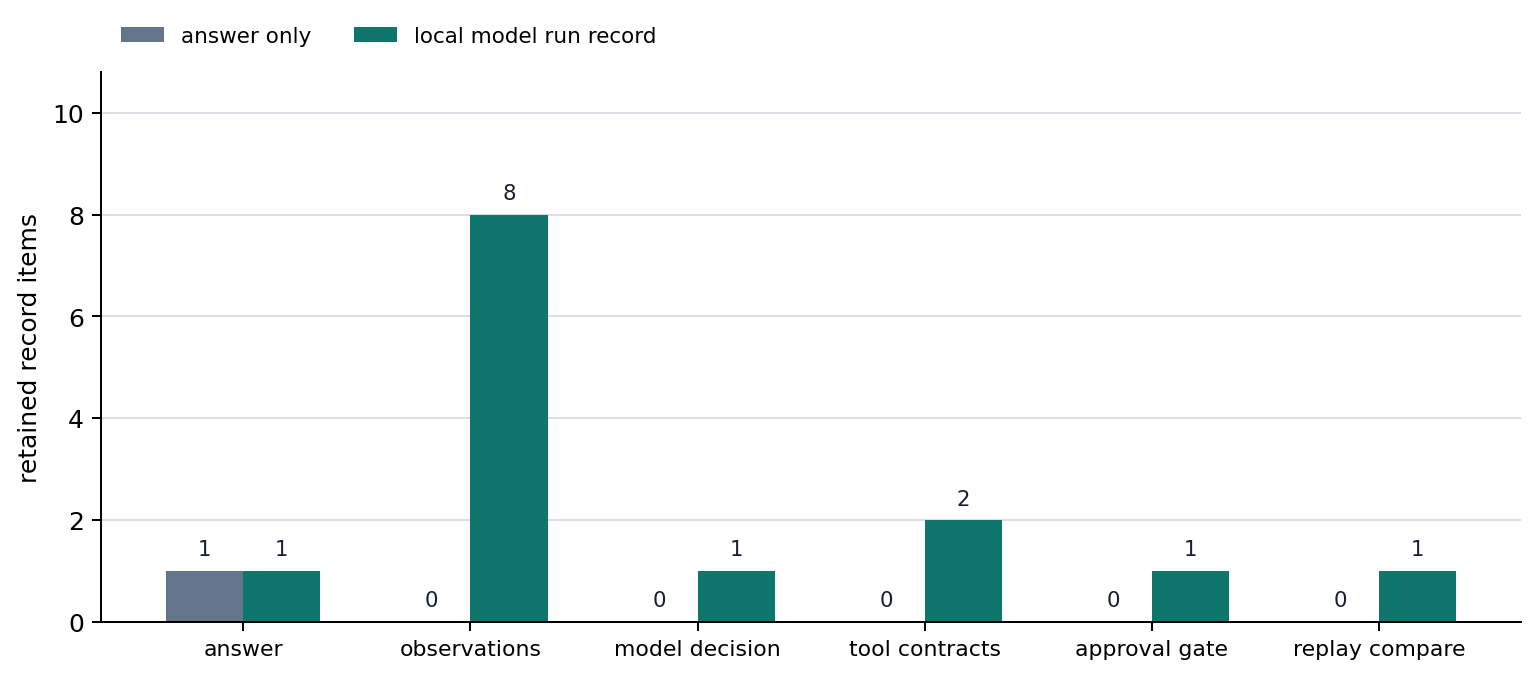
This chart compares a run that stores only the final answer with a run that leaves the local-model execution as a record artifact. The core is not the number of items. Model judgment, tool contracts, actual tool output, approval gate, trace group, saved run artifact, and replay comparison must remain together so that when the same request is run again, we can explain what stayed the same and what changed.
The same execution can be grouped by the three harness axes like this.
| Axis | What the code leaves | Why it is needed for reproducibility |
|---|---|---|
| Observation | observations | Input, retrieved candidates, model judgment, tool contracts, tool output, and gate status must be reviewable in the same order. |
| Report | run_report | The execution result and execution boundaries must be readable as a human-comparable summary. |
| Reproduction | save_run_record(), load_run_record(), compare_saved_runs() | Stored run records must be reloadable to compare a previous run with a new run. |
| Gate | needs_approval=True | Tools that must not run without approval need to be separated at the execution boundary. |
So the result to check in this example is not whether a specific refund answer is correct. The more important result is that even for the same request, the policy and answer chosen by the model can change when the order of search candidates changes, and the harness record leaves that difference as a replay comparison. At the same time, even when there is send intent, the approval gate remains in place and blocks actual sending.
Readers can try these adjustments in the example.
- Change the document order between
old_firstandcurrent_firstand see how the selected policy andstale_policy_selectedchange. - Change
OLLAMA_MODELtollama3.2:latestand see how model output quality and the possibility ofmodel_output_parse_errorchange. - Change
policy_versionto an arbitrary value innormalize_model_decision()and see whetherunknown_policy_versionis recorded and the flow falls back to the top document. - Remove
needs_approval=Truefromsend_refund_replyand see how the approval gate disappears from the report and howsend_statuschanges. - Remove the
save_run_record()call and see why previous and new executions become hard to compare even if observations exist. - Set
RUN_LIVE_AGENT=1andOPENAI_API_KEYand see whether the actualRunner.run()result is grouped under the sametrace.group_id.
One more step separates what a harness directly fixes from what evaluation or operations must judge again based on harness records.
| First visible signal | What the harness must leave | Judgment the harness does not make for us |
|---|---|---|
| Only the final answer remains | Input, tool-call trace, replay ID | The standard for comparing old and new executions |
| Before-and-after comparison is needed | Replay ID, execution settings, trace storage status | Re-evaluating under the same conditions whether regressions decreased |
| Execution went out without approval | Approval status and actual send path | Adding approval gates and strengthening automatic blocking policy |
| A specific failure cannot be reproduced again | Input, tool calls, intermediate-state records | Deciding whether non-reproducibility itself is an operational risk |
The key point of this table is that a harness is neither the level that judges good or bad nor the level that automatically fixes operational problems. A harness is the record layer that makes judgment and action possible. The evaluation chapter reads this record as quality criteria, and the operations chapter reads the same record as control and recovery action.
Execution records that become evaluation input
The previous example is not code that implements a whole commercial operation harness. It is a scene that checks the minimum observations and reproduction criteria needed when wrapping an SDK run. The important point is not listing many record items. It is that if only one result sentence remains, execution conditions and intermediate observations disappear, making replay comparison impossible.
The harness viewpoint is not a device that stores answer results, but an execution-record structure that makes the same execution explainable and comparable again. If we look only at the answer sentence, it is easy to say only acceptable or strange. But when the observation report, approval record, and replay information remain together, evaluation axes can be separated into questions such as was it the same request, was it the same tool result, and was it the same approval path.
At this point, the execution record moves into the next chapter as evaluation input. In P6-16, we will read not one result sentence, but the trace, evidence documents, approval state, and replayability left by the harness as quality criteria. In P6-17, we will read the same records again as operational controls such as cost, latency, failure blocking, and human review.
Checklist
- You should be able to explain a harness not as
one tool, but asan operational device that wraps execution, records it, and leaves evaluation input. - You should be able to say that MCP handles connection, while a harness handles execution management and reproduction criteria.
- You should know that evaluation is not an abstract judgment floating separately from the harness, but a stage that reads execution records through quality criteria.
Sources and Further Reading
- OpenAI, Integrations and observability, OpenAI API Docs, accessed 2026-07-19.
- OpenAI, Evaluate agent workflows, OpenAI API Docs, accessed 2026-07-19.
- OpenAI, Agents SDK, OpenAI API Docs, accessed 2026-07-19.