P6-17.2 Division of Work Between Automatic Evaluation and Human Evaluation
Section ID:
P6-17.2Version:v2026.07.31
Record evaluation division of labor as automatic_check, human_review, repeatable_rule, context_judgment, escalation_case, and review_note. This distinction keeps automatic evaluation, which is strong at repeatable checks, and human evaluation, which is strong at contextual judgment, from looking like substitutes for each other.
Subtitle: How are repeated checks and contextual judgment divided between automatic evaluation and human evaluation?
Once LLM evaluation axes are set, the next standard is deciding not to handle every evaluation in the same way. Items that can be checked mechanically and repeatedly, such as format errors, are easy to send first to automatic evaluation. Items that need contextual judgment, such as interpretation, nuance, and actual helpfulness, still need human evaluation.
Automatic evaluation is fast and repeatable, while human evaluation is better at context and quality sense. In real operations, the two are often used together. The evaluated target here is not the internal LLM algorithm, but the actual output produced by the model, such as answers, summaries, and guidance messages.
This also connects back to why we covered harnesses and MCP earlier. Output candidates, inputs, evidence documents, and tool-call records must remain so automatic evaluation can repeatedly check the same conditions and humans can later reread the same run. In other words, evaluation division of work is an operational structure for treating LLM outputs as reviewable service records.
Division of work between automatic and human evaluation
The core questions are:
- What is automatic evaluation strong at?
- What still requires human evaluation?
- Why do structures that mix both often appear?
The core is not is automatic evaluation better, or are people better. Even for the same output, some items are first marked for correction by an automatic grader, while other items move to a human review queue. Evaluation division of work moves away from one person reading the whole quality judgment end to end. It automates repeatable checks and leaves ambiguous judgments as review packets that people can read.
| Evaluation item | Easier for automatic evaluation | What human evaluation must still leave |
|---|---|---|
| Format compliance | JSON format, required fields, length limit, source presence | Whether the reading order is actually natural even though the format is valid |
| Groundedness | Source link, citation location, banned unsupported-expression detection | Whether the cited sentence actually supports the answer's conclusion |
| Helpfulness | Required item presence, next-action wording | Whether the user can actually understand the next action |
| Safety | Banned expressions, risky keywords, policy-violation candidates | Whether contextual misunderstanding or overconfidence remains |
So the central question is how should the same evaluation axes be divided between automatic graders and human review.
Separating repeated checks from contextual judgment
You should be able to explain the difference between automatic evaluation and human evaluation, distinguish repeatability from contextual judgment, explain why operations mix the two, and split evaluation results into candidates that need automatic fixing and candidates that need human review.
Rather than memorizing long definitions, it is safer to use the standard of why the same answer branches into stopped first by an automatic grader, sent to a human review queue, or left as a review packet.
| First visible answer state | Following evaluation route | Why the route splits this way |
|---|---|---|
| Format error, missing required field, basic criterion failure | Automatic fix needed | This is a mechanical failure to fix before a person reads the full answer. |
| Format is valid, but interpretation, nuance, or risk judgment is ambiguous | Human review queue | Automatic checks alone cannot fully read misunderstanding risk and helpfulness. |
| Automatic criteria pass, but contextual judgment remains | Human review packet | The output candidate and review questions must be bundled so a person can reread it in context. |
This table makes evaluation division easier to understand as a branching structure of where should this candidate stop and where should it go, not as a comparison of who is better.
What automatic evaluation is strong at
Automatic evaluation is usually strong at:
- fast repetition
- comparing many samples
- detecting regressions
- checking format
- checking items with clear criteria
For example, it is good for checking:
- whether JSON format is valid
- whether required fields exist
- whether retrieved document sources are attached
- whether a certain score became worse than the previous version
Automatic evaluation is strong at repetition and comparison.
What human evaluation is strong at
Human evaluation is usually strong at:
- understanding context
- judging subtle quality differences
- noticing awkward expressions
- judging real work fit
- judging social risk and misunderstanding potential
For example:
- the answer is formally valid but actually creates misunderstanding
- the explanation is fluent but does not fit the reader level
- evidence exists, but the wording is too categorical
These are easy to miss with automatic evaluation alone.
Human evaluation is better at context and nuance.
Why automatic evaluation alone is not enough
Automatic evaluation is strong when criteria are clearly defined, but it is hard for it to replace all quality judgment.
For example, automatic evaluation can often check:
- whether a specific keyword exists in a document
- whether a format constraint was followed
- whether a score crossed a threshold
But it has limits in judging:
- whether the answer is actually trustworthy and usable
- whether the wording can mislead the user
- whether it fits the organization's real purpose
Why human evaluation alone is also not enough
If evaluation relies only on people, other problems appear.
- It is slow.
- It is costly.
- Standards can differ across reviewers.
- It is hard to repeat frequently.
Human evaluation has depth, but as operations scale, it is hard to sustain without automation.
Why both are used together
In practice, the two are usually mixed like this.
- Automatic evaluation first catches large-scale regressions and format errors.
- Human evaluation checks important samples and subtle quality issues.
- Automatic criteria are reinforced again when needed.
Automatic evaluation and human evaluation are therefore more similar to a division of work than to replacements for each other.
In operational flow, this division can be read more briefly like this.
| Evaluation route checked first | What it catches best | Where it goes next |
|---|---|---|
| Automatic grader based on a fixed evaluation set | Regressions, format errors, basic groundedness signals | Human review or automatic-fix-needed state |
| Human review | Ambiguous interpretation, nuance, actual helpfulness, high-risk samples | Fix, hold, or approve decision |
Automatic evaluation is strong at repeated comparison, and human evaluation is strong at interpreting ambiguous candidates and high-risk samples. This is why practical external curricula often keep automatic evaluation sets and human review together.
Before and after deployment, the same questions can be run through an automatic evaluation set to find regressions and format errors first, while human evaluation checks whether those changes matter to real user experience. Automatic evaluation is a broad filter, and human evaluation interprets the meaning of the remaining candidates.
Simplified once more:
flowchart LR
  A["candidate outputs"]
  B["automatic gate"]
  C["review packet"]
  D["human context judgment"]

  A --> B
  B --> C
  C --> D
The key point in this figure is that automatic evaluation does not finish all judgment first. It reduces the candidates that need human review and helps decide final action faster.
Drawn very simply
flowchart TD
  A["system outputs"]
  B["automatic checks"]
  C["human review"]
  D["combined quality decision"]

  A --> B
  A --> C
  B --> D
  C --> D
The key point of this diagram is that actual quality judgment does not end through only one path.
Another important point is that automatic and human evaluation results become inputs to operational judgment. The end of evaluation division is not simply quality judgment complete; it is more similar to a state where candidates have been sorted into continue or stop paths.
| Judgment left by evaluation division | Question read again in operations |
|---|---|
| Whether the automatic grader passed | Can this candidate move to full human reading? |
| Whether human review is needed | Which path should it move to: fix, hold, or approval? |
| Human review packet | What questions should a person use when rereading it? |
| Failure or review reason | Which cause should failure handling trace first? |
Automatic and human evaluation are not procedures that simply say good or bad. They are baselines for splitting candidates into operational routes.
Cases and examples
The focus of these cases is not what is correct, but which failures are filtered automatically and which failures must be read by people to the end.
Case 1. Evaluating RAG answers
Suppose a RAG answer includes both a source link and a cited span. If links and format are attached well, it is easy to feel first that there is evidence. Automatic checks can quickly confirm is there a source and is the format valid, but a link does not mean the answer actually reflects the document's meaning. For example, the document may contain an exception clause while the answer reads only one main sentence and states always possible.
In that case, automatic checks may pass while the actual user guidance is wrong. This interpretation error appears only when a person reads the document and answer together. Automatic evaluation checks is evidence attached, while human evaluation checks was the evidence read correctly. The criterion changes from is there a source link to does the source actually support the interpretation.
This matters in real operations because passing automatic checks can create too much comfort. If links and citation formatting are present, many teams first feel that the answer is grounded. But what automatic checks see well and what people must read to the end are different. Automatic checks filter surface structure quickly, while exception interpretation and contextual overstatement require reading the source and answer together.
| Answer state | What automatic evaluation can see first | What human evaluation must read to the end |
|---|---|---|
| Link and citation format both exist | Source presence, format pass | Is there no categorical claim that omits an exception clause? |
| Cited paragraph exists | Paragraph reference is not empty | Does the paragraph actually support the answer condition? |
| Answer is natural and short | Length and format are fine | Did shortening remove a key limitation? |
The misunderstanding this table corrects is expecting that if a source link exists, the interpretation is also mostly correct.
Case 2. Evaluating AI agent execution records
Even if an AI agent produced a final answer, the execution record may contain signals such as repeated search, failed tool calls, or repeated reads of the same document. Automatic evaluation can quickly mark whether these signals exist. But whether the signal is actually a problem or a necessary confirmation step requires a person to read the record together.
For example, if similar searches are repeated several times even after enough documents were found in the first search, automatic evaluation can leave a repeated call signal. But whether that repetition was an unnecessary detour or a needed recheck of ambiguous evidence depends on the execution flow. The criterion changes from did a final answer appear to does the automatic signal become a human-review question.
The result to check in this case is not cost calculation or operation optimization itself. That judgment is handled more directly in P6-17's operational constraints. Here, we only need to hold the division of work: automatic evaluation first gathers abnormal signals from the execution record, and human evaluation rereads those signals in context.
| Execution record state | Signal automatic evaluation catches well | Question human evaluation should ask next |
|---|---|---|
| Similar searches are repeated | Repeated-call signal | Was it necessary evidence checking or an unnecessary detour? |
| Failed tool call remains | Failure signal | Did it repeat the same failure or recover through another path? |
| Final answer exists | Success flag | Did success hide intermediate risk signals? |
The important standard is not wrapping up evaluation with only success/failure. Automatic evaluation gathers abnormal signals, and human evaluation interprets whether those signals are actual quality problems.
Case 3. Customer-support answer
Suppose a customer-support answer is fast, has no banned terms, and follows format. It is easy to feel that if automatic evaluation passed everything, it is almost enough. But if the actual sentence sounds too cold or shifts responsibility to the customer, service quality can still be poor. Conversely, even if the sentence is polite, the customer can still be confused if the action order is awkward.
For example, if the answer explains the document-submission route for a long time before saying whether a refund is available, the facts may be right but the customer may still not understand the answer. This does not show up well in format checks; people need to read it. In customer-support scenes, automatic evaluation is a basic guardrail, while human evaluation checks misunderstanding risk and tone quality.
| Situation | Good target for automatic evaluation first | What human evaluation must read to the end |
|---|---|---|
| RAG answer evaluation | Source presence, format match, citation notation | Was the exception clause interpreted correctly? |
| Agent execution record | Repeated-call signal, failure signal, success flag | Is the signal a real quality issue or a necessary contextual check? |
| Customer-support answer | Banned terms, format, length, response speed | Tone, misunderstanding risk, next-action clarity |
Scenes where automatic and human evaluation should split
A common misunderstanding is leaning to one side: automatic is better because it is faster, or humans are more accurate, so automation matters less. In real operations, the core is separating what should be filtered automatically first from what must be left to people to the end.
| If you suspect this | First question to ask |
|---|---|
Does a person really need to see this? | Can it be repeatedly checked by an automatic grader, like format, length, or source presence? |
Automatic checks passed, so why is it still unsettling? | Did a person reread nuance, misunderstanding risk, and actual helpfulness? |
Why do some answers get fixed immediately while others go to people? | Is the boundary between automatic-fix-needed and human-review-queue defined? |
The standard to learn first is simple. Automatic evaluation is stronger at quickly filtering repeatable surface criteria; human evaluation is stronger at judging ambiguous interpretation and actual helpfulness to the end. In operation, they should be read as division of work, not competition.
Practice and example
The goal of the example is to see that automatic evaluation and human evaluation have different roles through different check items. Instead of looking at one answer, we compare several LLM output candidates and ask what does automatic evaluation stop first through repeated checks and what moves to a review packet for a person to read.
The example uses the English evaluation-routing candidate CSV p6_16_2_eval_routing_cases_en.csv. One row is one LLM output candidate that can appear in operation. model_output is the candidate answer, and source_marker, required_action, format_marker, max_length, and banned_terms are criteria the automatic grader checks repeatedly. The CSV does not contain prewritten human risk labels or answer labels.
The automatic grader names continue from P6-17.1's evaluation axes. source_marker_grader maps to groundedness, required_action_grader maps to helpfulness, format_grader and length_grader map to format compliance, and banned_terms_grader maps to safety. This mapping also appears in the code's GRADER_AXIS_MAP.
The output shows code-grader results for each candidate, optional LLM-as-a-judge results, human review packets, and a routing summary. The key point in the code is that it does not let code replace human evaluation. The code first checks repeatable surface criteria and then creates candidate sentences plus review questions for candidates that pass.
The local LLM judge is attached only to sample candidates when Ollama is running. Ollama is not used here to teach a specific product workflow; it is only a local way to show that an LLM can also be attached as one type of automatic grader. The prompt passed to the LLM judge stays in English and includes code-grader signals such as required action exists and banned expression absent. This keeps the LLM judge from looking like a replacement for human evaluation. It should be read as a supporting automatic grader that refers to repeatable check results.
The operational judgment criteria to read together are:
| Check item | Why it is needed |
|---|---|
| Automatic grader pass status | To see whether basic guardrails such as format, length, evidence hint, and banned terms pass first |
| Automatic grader fix note | To separate mechanical fixes needed before human review |
| Human review packet | To let people read evidence interpretation, helpfulness, tone, and omissions even after automatic pass |
| Automatic-fix-needed status | To separate mechanical failures before people read the answer |
| Routing summary | To clearly record how automatic-fix-needed and human-review queues split |
1 2 3 4 5 6 7 8 9 10 11 12 13 14 15 16 17 18 19 20 21 22 23 24 25 26 27 28 29 30 31 32 33 34 35 36 37 38 39 40 41 42 43 44 45 46 47 48 49 50 51 52 53 54 55 56 57 58 59 60 61 62 63 64 65 66 67 68 69 70 71 72 73 74 75 76 77 78 79 80 81 82 83 84 85 86 87 88 89 90 91 92 93 94 95 96 97 98 99 100 101 102 103 104 105 106 107 108 109 110 111 112 113 114 115 116 117 118 119 120 121 122 123 124 125 126 127 128 129 130 131 132 133 134 135 136 137 138 139 140 141 142 143 144 145 146 147 148 149 150 151 152 153 154 155 156 157 158 159 160 161 162 163 164 165 166 167 168 169 170 171 172 173 174 175 176 177 178 179 180 181 182 183 184 185 186 187 188 189 190 191 192 193 194 195 196 197 198 199 200 201 202 203 204 205 206 207 208 209 210 211 212 213 214 215 216 217 218 219 220 221 222 223 224 225 226 227 228 229 230 231 232 233 234 235 236 237 238 239 240 241 242 243 244 245 246 247 248 249 250 251 252 253 254 255 256 257 258 259 260 261 262 263 264 265 266 267 268 269 270 271 272 273 274 275 276 277 278 279 280 281 282 283 284 285 286 287 288 289 290 291 292 293 294 295 296 297 298 299 300 | |
The example output can be read like this when the optional local LLM judge is disabled or unavailable.
The first thing to notice is that the code does not imitate human judgment. A candidate such as case_002, which is missing the required next action, and a candidate such as case_007, which includes a banned expression, stop at the automatic grader before human review. By contrast, a candidate such as case_001, which passes repeated check criteria, is not approved immediately. It moves to the human review queue with a packet that a person can read.
Another value to watch is reason_source when the optional LLM judge is available. If reason_source is llm, the local LLM judge produced the reason directly. If it is code_grader_fallback, the LLM judge's reason was empty or weak, so code-grader observations reinforced the reason. This distinction matters because the LLM judge itself is also something to review. Automatic grading does not end with one LLM judgment; it records code-check signals and LLM-judge signals together and leaves room for conflict.
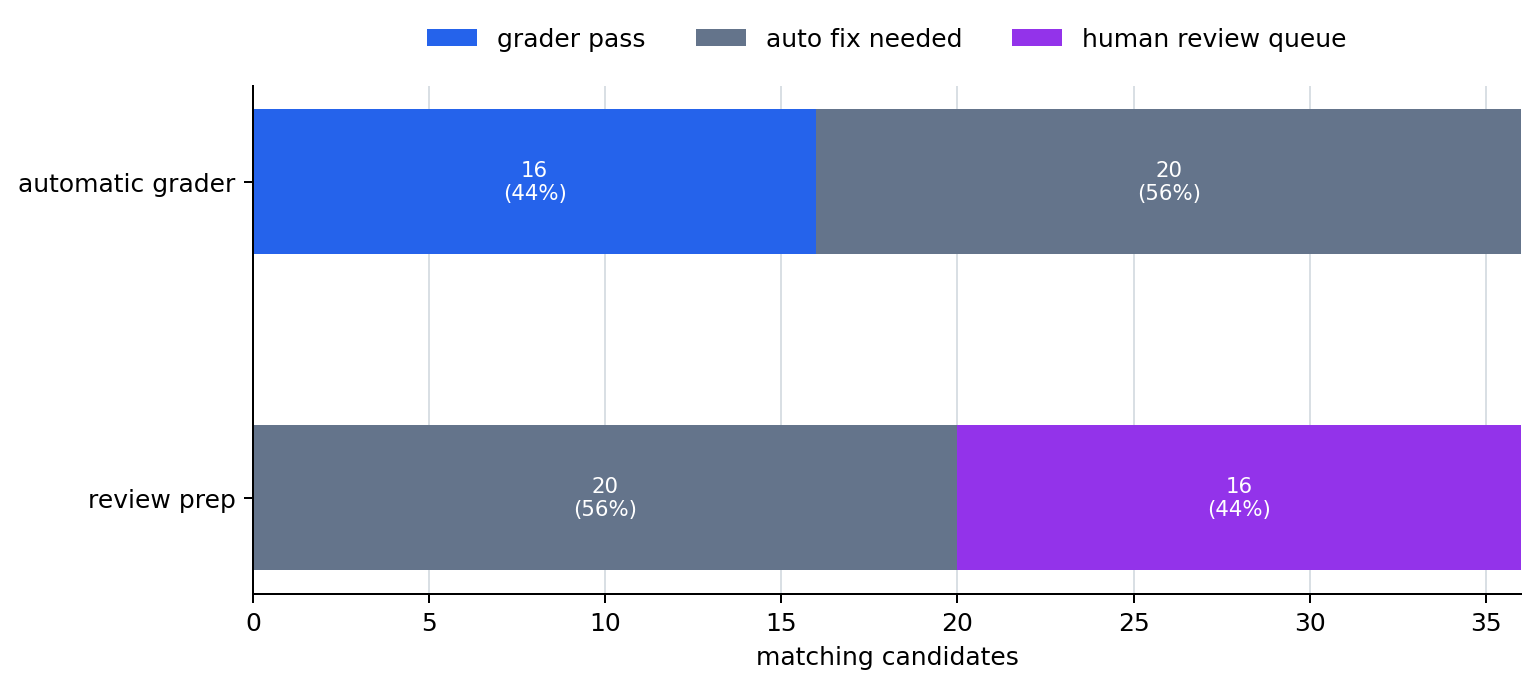
This chart shows that the first row splits candidates into automatic-grader pass and fail, while the second row sends failed candidates to automatic fix and passed candidates to the human review queue. An automatic pass is therefore not an approval result. It is an intermediate state organized so a person can read further.
The same result can be grouped briefly by operational route.
| Candidate | First visible state | Why it goes this route | Follow-up action |
|---|---|---|---|
case_001 | Human review queue | It passed automatic graders, but evidence interpretation, usefulness, and tone still need human reading. | Bundle into a review packet and send to a person |
case_002 | Automatic fix needed | It has the notice signal, but the next action, order number request, is missing. | Fix the output candidate and rerun automatic grading |
case_007 | Automatic fix needed | It has required signals, but includes a banned expression such as always possible. | Revise the categorical expression and rerun automatic grading |
The result to check in this example is that automatic evaluation quickly checks repeatable conditions such as format, length, evidence hint, and banned terms, while human evaluation separately checks actual helpfulness, misunderstanding risk, tone quality, and interpretation of policy exceptions. In operation, automatic graders do not replace the final human judgment. They make the set of candidates humans read smaller and more reproducible.
Readers can try these adjustments in the example.
- Remove or add next-action guidance in the CSV's
model_outputand see howrequired_action_graderchanges. - Change
banned_termsor candidate wording and see howbanned_terms_graderchanges. - Change
AIBOOK_OLLAMA_MODELand see how the optional LLM judge's score, reason, andreason_sourcechange. - Adjust
max_lengthand see how the length limit works at the automatic-grader stage before human review. - Change
HUMAN_REVIEW_RUBRICand see how the review packet attached to automatically passed candidates changes.
Human review remaining after automatic grading
The previous example is not a complete implementation that imitates human evaluation in code. It shows that the same output becomes a different work state after passing through automatic graders and human review packets. The core point is that increasing automatic checks and reducing human review are not the same goal. They are a division of work for catching different failures.
In one line, automatic evaluation and human evaluation are not a relationship of which is superior; they are an operational division of work that separates which candidates should be mechanically fixed first and which candidates should be read in context by people.
The more important point is that filter many cases quickly and check important errors to the end cannot be solved through the same review path. Automatic and human evaluation should therefore be read as an operational division that decides where a candidate stops and how far it moves up.
This division matters because it:
- extends P6-17.1's evaluation axes from
what to checktohow to check - turns evaluation from a score table into a reviewable operational process
- connects the same output candidates to records and failure handling that can be reviewed repeatedly
- sets criteria for later verification procedures
Checklist
- You should be able to explain that automatic evaluation is strong at
repetition and comparison, while human evaluation is strong atcontext and subtle quality judgment. - You should be able to say that operations can shake with automatic evaluation alone or human evaluation alone, so the two should be used together.
- You should know that quality judgment does not stop here, but continues into how candidates are left as records and review routes.
Sources and Further Reading
- OpenAI, Getting started with datasets, OpenAI API Docs, accessed 2026-07-24.
- OpenAI, Graders, OpenAI API Docs, accessed 2026-07-24.
- OpenAI, Evaluate agent workflows, OpenAI API Docs, accessed 2026-07-24.
- Yupeng Chang et al., A Survey on Evaluation of Large Language Models, arXiv, 2023, accessed 2026-07-24.