P6-6.1 BERT as a Reading-Centered Transformer Comparison Axis
Section ID:
P6-6.1Version:v2026.07.26
Even within the same Transformer family, one flow is strong at reading the whole input, while another flow is strong at generating the next token.
The BERT family is an encoder-centered Transformer flow that reads the whole input context and creates representations. It tends to fit understanding, classification, search, and embedding tasks better than generation.
When learning generative AI, it is easy to think all Transformer-family models are similar. But in real services, a structure that reads a sentence and outputs a judgment value and a structure that continues generating the next token are used differently. This distinction is needed to explain why the BERT family still matters in the front end of search, classification, and embeddings.
The important comparison question is: BERT is also a Transformer, so why is its role different from GPT? Instead of opening a long new main flow, it is safer to build a comparison criterion between the generative flow we have already read and a reading-centered Transformer family.
Reading-Centered Transformer Comparison Axis
The comparison begins with these questions.
- Where does the BERT family sit inside Transformers?
- Why is BERT explained as a model that sees the whole input together?
- From which viewpoint should it be read differently from the GPT family?
It is safest to hold the BERT family as an encoder-centered Transformer flow that reads the whole input. Then its different use from the GPT family becomes clearer.
However, before extending BERT's roles into classification, search, sentence-pair judgment, and embeddings, the structural difference should be fixed first. Practical connections to search and embeddings can be reread together with the search pipeline explanations in P6-13.1 and P6-13.2.
BERT has not simply been pushed away as an old model before LLMs. It remains an important encoder-based flow in the front end of classification, search, and embeddings. Here, instead of moving the main flow of Part 6 into BERT, we focus on setting a criterion for comparing the GPT family and the generative AI main flow more accurately.
If we compress only the comparison axes to keep, these four lines are enough.
| Comparison axis | BERT family | GPT family |
|---|---|---|
| Central structure | encoder | decoder |
| Reading method | reads the whole input context together | looks at previous tokens and creates the next token |
| Representative output | label, score, relevance, embedding | following token, sentence, answer |
| Strong first tasks | classification, search, sentence-pair judgment | generation, conversation, drafting |
Separating Reading-Centered and Generation-Centered Structures
- You can explain the BERT family as an encoder-centered Transformer flow.
- You can explain the difference between BERT and GPT by
context-reading methodandmain task, not only by whether they generate. - You can say why the BERT family connects well to tasks such as classification, search, and embeddings.
- You can read understanding-centered tasks as an extension of structural comparison.
BERT Acronym Meaning
BERT stands for Bidirectional Encoder Representations from Transformers. But seeing the acronym all at once can make it feel even more unfamiliar. Instead of memorizing the name, it is better to first read why those words are attached.
- bidirectional
- encoder
- representations
- Transformers
Each word can be explained briefly as follows.
| Word | Meaning to read here |
|---|---|
| bidirectional | reads earlier and later context together |
| encoder | reads input and turns it into representation |
| representations | creates contextual representations that can be reused for classification, search, and comparison |
| Transformers | the base structure that creates those representations is Transformer |
So BERT's name contains the idea that a Transformer encoder reads the whole sentence together and creates context-aware representations.
It is enough to first remember this line:
BERT is a model flow that reads a sentence to the end and turns it into a representation that can be reused for later tasks.
With this criterion, it becomes clearer why the GPT family we read earlier is explained as a continuing generation structure rather than a read-and-judge structure.
Why Is BERT Said to See the Whole Input?
The GPT family is usually explained as an autoregressive flow that predicts the next token from left context. By contrast, the BERT family uses both earlier and later context inside the input sentence to create the representation of a position.
Consider this sentence:
I deposited money at the bank.
To read the meaning of bank, the later phrase deposited money matters.
Now consider another sentence:
I sat on the bank of the river.
The same word bank appears, but the later context is different, so the meaning changes.
The core intuition of the BERT family is:
The representation of one token is made not only from the token itself, but from the whole surrounding context.
Why Is BERT Closer to Understanding Than Generation?
Using the word understanding in an overly human way is risky. A safer explanation is:
The BERT family is strong at reading a whole sentence and creating contextual representations, so those representations connect well to tasks such as classification, search, and sentence-pair comparison.
So BERT is better read as:
- not a structure optimized for generating a long next sentence,
- but a structure strong at turning input into a representation space that can be interpreted.
What Is Different Compared with GPT?
Readers often ask:
- Is BERT an understanding model and GPT a generation model?
The direction is right, but it becomes misleading if it is too simple. A safer comparison is:
| Category | BERT family | GPT family |
|---|---|---|
| Central structure | encoder | decoder |
| Basic intuition | read the whole input and create representation | see previous tokens and generate the next token |
| Strong tasks | classification, search, sentence-pair judgment, embedding | generation, conversation, summary, drafting |
| Reading method | uses bidirectional context | sequential prediction aligned with generation direction |
The key in this table is not a ranking of which is better, but a difference in use. The result to confirm from it is whether you can actually read BERT and GPT as which task fits first?, not as which one is better?, even though both belong to the Transformer family.
Why the BERT Family Still Matters
Because of the generative AI boom, the BERT family can look like past technology. But in real services, it is still important in sections that need reading, classification, and ranking in the front end rather than long answer generation.
For example:
- document classification,
- sentiment analysis,
- search ranking,
- sentence embeddings,
- relevance judgment between query and document,
still fit well with encoder-family representation models.
GPT opening a broad generative interface does not mean the BERT family's position disappeared.
This point is easier to hold if you think of an intent-analysis tool for chatbots. Commercial cloud services often include features that read a user's sentence and attach intent labels such as refund request, delivery lookup, and password reset. Product screens and settings change often, but the central structure is still close to read the input and judge the appropriate label or relevance.
Why BERT and GPT Should Be Distinguished Together
At this point, the need for comparison becomes clearer. The core of this section is not to dig into BERT at length in isolation. It is to first distinguish that even inside the same Transformer family, structures that read and judge and structures that continue generation support different tasks. Once this criterion is set, P6-5.1 The GPT Family as a Decoder-Based Cumulative Generation Structure and P6-7.1 Next Token Prediction as the Starting Point of Long Generation can be read more directly together.
BERT and GPT Split by Input and Output
The difference between generative models and the BERT family becomes easier to grasp by asking what comes in and what comes out.
| Viewpoint | What appears first in the BERT family | What appears first in the GPT family |
|---|---|---|
| Input | one sentence, sentence pair, question-document pair | prompt, conversation history, previous generated tokens |
| Intermediate representation | context-aware token representation, sentence representation | next-token probability distribution |
| Output | label, score, relevance, embedding | following token, sentence, answer draft |
The BERT family is closer to read and output a judgment value, while the GPT family is closer to read and continue the next output.
This difference also appears in chatbot operation tools. Intent classification or routing tools usually first decide which flow this user sentence should be sent to. A generative chatbot, by contrast, puts the experience of writing a long answer sentence at the front in the next stage. So the two are not necessarily competitors. Inside a service, they may be used together as front-end reading and classification and back-end generation and response.
A Very Simple Diagram
flowchart TD
  A["input tokens"]
  B["encoder Transformer layers"]
  C["contextual token representations"]
  D["classification / ranking / embedding tasks"]

  A --> B --> C --> D
The result to confirm in this diagram is that the BERT family does not read a sentence and immediately generate a long answer. It creates contextual representations, and then connects those representations to classification, search, and embedding tasks.
Cases and Examples
Case 1. Document Classification
When first seeing document classification, it is easy to begin by counting whether a word close to the label appears. But in real inquiry operations, which processing flow should this be sent to? matters more than surface words.
Even without the word refund, an inquiry may be about refund status. Even if the word cancel appears, the actual bottleneck may be account authentication. This scene shows why the BERT family is explained as a reading-centered structure that more stably captures the processing intent of the whole sentence. The result to confirm in this case is whether inquiries with different surface words gather more stably into the same processing queue.
Even for the same inquiry, surface-word criteria and whole-sentence criteria can produce different results.
| Inquiry expression | Judgment likely from keyword rules alone | What a reading-centered model tries to capture first |
|---|---|---|
When will the money come back? | May miss it because the word refund is absent | Refund-status inquiry after payment cancellation |
I canceled the order but the payment still appears. | May drift because surface words such as cancel or refund are weak | Intent to check cancellation/refund processing status |
I cannot log in, so I cannot cancel my order. | Seeing cancel, it may push the case into refund/cancellation | Whether the real bottleneck is account authentication or order cancellation |
This table corrects the misunderstanding that if a word similar to the label name appears, it is almost enough. A reading-centered model is needed in document classification because it captures processing intent more directly than surface words.
Case 2. Search Ranking
Search ranking also often starts with title keyword matching, but top results easily drift when user expressions and document expressions differ slightly. A user may search for return equipment, while the document says asset recovery; another user may search for resignation, while the title says offboarding procedure.
This scene shows why a reading-centered model such as the BERT family is explained as reading the relationship between the whole question and the whole document before simply counting overlapping words. The result to confirm in this case is whether a procedure document that is actually more relevant rises above a document with only more matching words.
The reading criterion changes as follows.
| Question-document relationship | What keyword criteria may raise first | What reading-centered ranking tries to raise first |
|---|---|---|
The question directly includes equipment and return | A document with many identical words in the title | A document explaining the equipment recovery step inside the real offboarding process |
The document title only says offboarding procedure | It may be pushed down because word overlap is low | Connection between pre-resignation procedures and the question intent |
The document uses a different expression such as asset recovery guide | Surface words differ, so it may be missed | Semantic relevance between the whole question and the whole document |
The important criterion in this case is separating how many words overlap? from are they actually talking about the same procedure? The BERT family is needed in search ranking because those two often diverge.
Case 3. Sentence Similarity and Intent Classification
I want to change my password and How do I reset my login password? can be the same resolution path even though their surface words differ. Conversely, Login keeps failing may look similar, but require a different processing flow.
Cloud chatbot intent classification is similar. It is more stable when it first reads which processing flow the whole sentence asks for, rather than detecting only words. This scene compresses why the BERT family fits read-and-distinguish judgment structures better than long answer generation. The result to confirm in this case is whether same-intent sentences group closer, while sentences requiring different processing flows separate.
The three cases can be grouped through the viewpoint of reading-centered judgment.
| Situation | What keyword rules can easily mishandle | What a reading-centered model tries to capture first |
|---|---|---|
| Document classification | Same inquiry with different surface words | Same processing intent |
| Search ranking | Document with only a similar title | Procedure document that is actually related to the question |
| Sentence similarity / intent classification | Sentences that look similar but need different resolution paths | Separation of same intent and different intent |
Choosing Between Reading and Generation
A common misunderstanding when reading the BERT family is to see it as less important because it cannot write long answers like GPT. But the first thing to check is not the size of generation ability. It is is the needed work reading and judgment, or continuation writing? Turned into practical questions, this reads as follows.
| If this suspicion appears | First question to ask |
|---|---|
Should this produce a long answer, or classify first? | Is the needed output a sentence or a judgment value? |
What should happen before finding documents? | Is a front end needed that reads relevance between question and document? |
Isn't knowing generative AI enough for everything? | Are front-end reading, ranking, and embedding still needed? |
The first criterion to learn is simple. The BERT family is closer to a structure that reads a sentence to the end and creates representations and judgment values, while the GPT family is closer to a structure that reads and then continues generating the next token. The difference in use should be read before ranking superiority.
Exercise
The goal of the exercise is to check through a judgment table, not code, that even with the same surface word, reading context to the end can change interpretation and downstream label. To first hold the structural position of the BERT family, focus on context reading and output direction rather than an actual label, score, or ranking experiment.
The exercise below checks a structure where an understanding-centered model reads a sentence and passes it to a judgment value, unlike a generative response. Given four sentences with the same surface word or similar topic, compare a simple label attached without context, the interpretation after reading context to the end, and the label passed to the next task.
The key to confirm is that even if the same word appears, interpretation and downstream labels can change only after reading context to the end. An understanding-centered model first creates interpretation results and task labels rather than long answers, and surface-keyword criteria and context-interpretation criteria can create different output structures from the same input.
The exercise uses the example sentence list organized above.
| Input sentence | Label likely from surface keywords alone | Interpretation after reading the full context | Next task label |
|---|---|---|---|
| I want to deposit money at the bank | financial_topic | Situation of depositing money at a financial institution | finance_intent |
| I am walking under a tree on the bank of a river | financial_topic | Nature scene involving a riverbank | nature_description |
| I want to reset my password | account_topic | Account access problem | account_intent |
| I canceled the order but the payment still remains | payment_topic | Payment-status issue after order cancellation | order_support_intent |
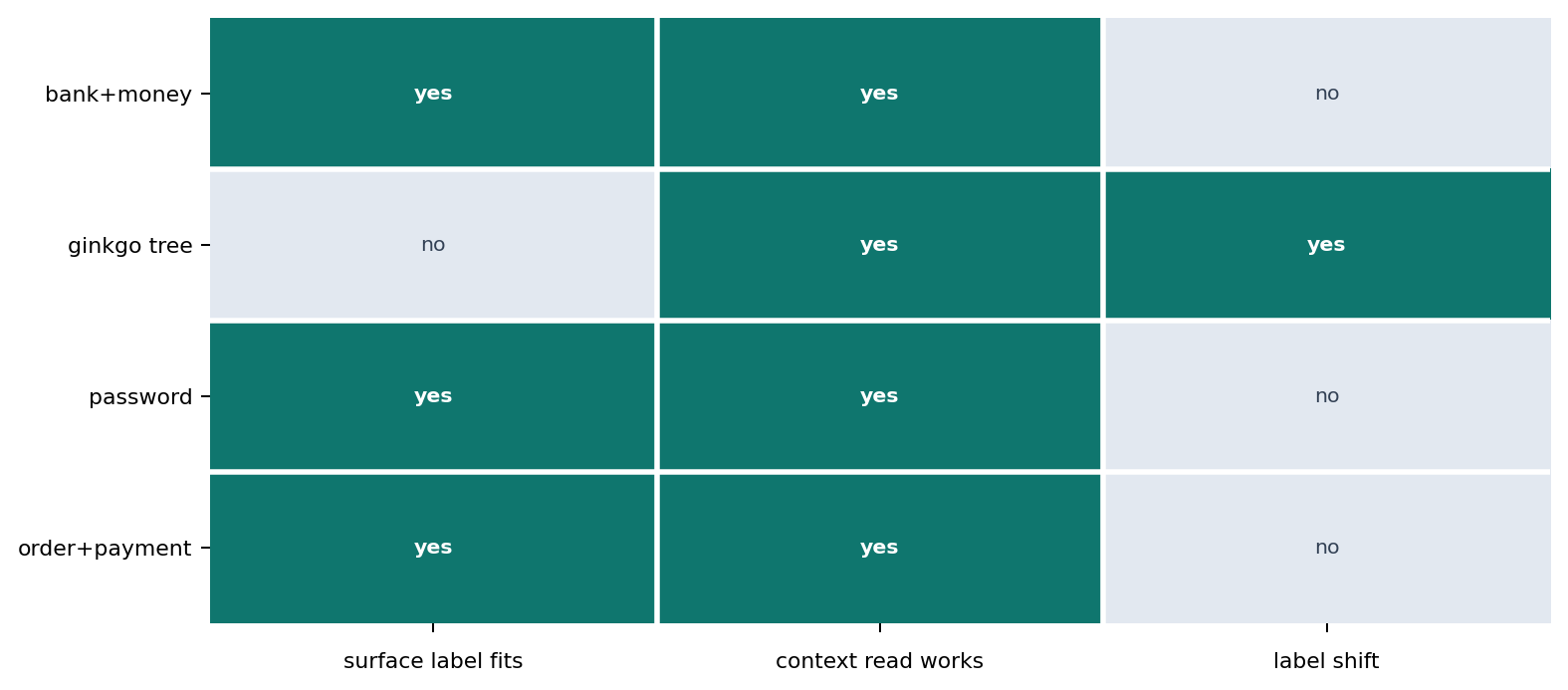
The core points to read from this exercise are:
- even with the same word, interpretation can change depending on surrounding context;
- simple keyword labels can incorrectly group the first and second sentences into the same topic;
- contextual interpretation connects to downstream tasks such as classification or intent judgment; and
- the BERT family fits this flow of
read the whole sentence -> create representation -> connect to judgment task.
Readers can try these adjustments directly:
- Add
I cannot log in to the banking appto the table and decide whether the first label should be a financial topic or an account-access problem. - Add
I cannot log in, so I cannot cancel my orderand explain which is needed first: order-cancellation label or account label. - Write how the output differs when the same sentence is treated as a GPT-family answer-generation problem versus a BERT-family routing problem.
Output Differences That Appear First in Reading Models
This exercise shows that even without continuing a long answer like a generative model, reading a sentence to the end and deciding which judgment to pass it to is an independent and important ability. So when looking at the BERT family, it is more accurate to position it not as a competitor to generation, but as a reading-centered model that handles the front end of classification, search, and routing.
BERT strongly showed that Transformer could expand beyond translation structures into language understanding tasks.
Historically, BERT mattered because:
- it showed that Transformer encoder-based pretraining transfers well to a very wide range of downstream tasks;
- it greatly raised the quality of contextual representations; and
- it quickly changed practical workflows in classification, search, and embedding families.
The final result to keep is clear. Even in the age of generative AI, the role of models that read, distinguish, and connect has not disappeared. It remains a separate axis in front-end tasks such as classification, search, and embeddings. With this criterion, GPT-family explanations are less likely to be read as the single answer to all language tasks, and the BERT family can be separated again as a different structure responsible for reading and judgment.
Checklist
- You should be able to explain BERT not as an
old model, but as a representative comparison axis in the reading-centered Transformer family. - You should be able to explain the difference between BERT and GPT not as superiority, but as whether the model
reads the whole input and creates a judgment valueorcontinues generating the next output. - You should hold understanding-centered tasks as a viewpoint that narrows this structural comparison into practical task groups.
Sources and References
- Jacob Devlin et al., BERT: Pre-training of Deep Bidirectional Transformers for Language Understanding, arXiv, 2018, accessed 2026-07-19.
- Matthew E. Peters et al., Deep contextualized word representations, arXiv, 2018, accessed 2026-07-19.
- Daniel Jurafsky, James H. Martin, Speech and Language Processing, draft materials, accessed 2026-07-19.