Show Cover Slide
gpt-4-turbohas translated this article into English.
Structuring a Development Organization by Domain and Designing Recruitment Criteria: A Case Study
This case study describes structuring the development organization by domain and designing recruitment criteria and interview flows for launching a new service. It was a process of completing a flow that could solve problems with people, not just hiring technicians.
Problem Recognition
The company wanted to implement an unmanned strategy, but
there was no dedicated development organization to handle this internally,
and it wasn’t even clear what roles were necessary.
Hiring without clear job definitions was seen as a limitation to embedding technology within the organization as it expanded.
My Design Philosophy
I view recruitment not as “selecting people” but as
a design task that completes structures capable of solving problems with people.
More important than technical skills is
the mindset that understands the business context and can resolve it through technology.
Design Direction
-
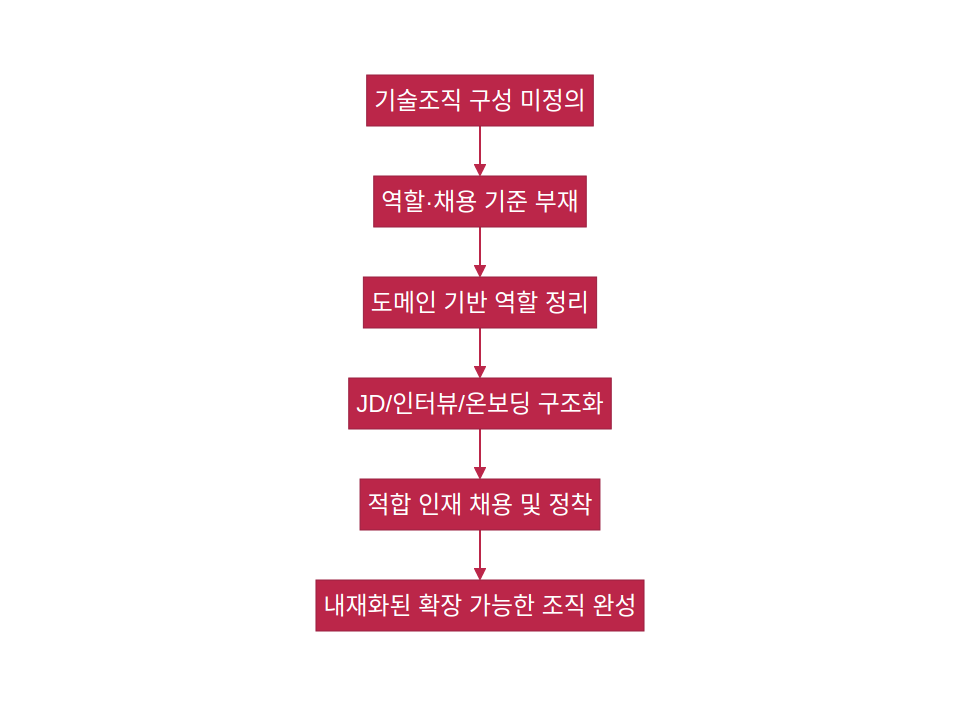
Structuring the organization into 4 domains
→ Service Platform / Data Platform / Devices / Operations -
Analyzing external cases and job definitions to reconstruct roles that fit our business
→ Reconstructing JDs to align with our strategy instead of existing market definitions -
Formalizing interview structures and evaluation criteria
→ Modularizing repetitive questions and focusing on problem-solving rather than just technical skills -
Designing the flow including onboarding structure post-recruitment
→ Structuring systems to ensure alignment with strategic growth even after joining
Results
- Placement of several talents into appropriate domains based on role definitions
- Acquisition of technical talent based on understanding of business
- Completion of dedicated development organization → Foundation for internalization of technology
- Flexible redeployment possible in future service expansions due to domain-centric organizational structure
In Summary
A technology organization is not made up solely of technology.
Proper role definitions, context-focused evaluation criteria, and a structured onboarding process are necessary for technology to truly integrate within the organization.
Our team was completed over about 6 months, and launched its first service to the market just 4 months later.
- From service development
- Contracts with third-party suppliers,
- Designing operational agency processes,
- To the flow of customer delivery, everything was internally concluded.
As a result, about 150 customers were able to directly experience our service. Although not a massive growth, the entire process of recognizing the problem, structuring, and executing in such a short time was considered a meaningful achievement.
From this experience, I am convinced that a technology organization can also be designed like a platform.
Going forward, I plan to spend most of my time designing people and structures before adopting technology.
Go Home